Credit Card Payoff Calculator
This credit card payoff calculator estimates how many months a balance takes to clear with a fixed monthly payment and constant APR. It charges monthly interest, caps the final payment at the amount owed, and assumes no new purchases or fees.
By Dr. Hassan Khames EliwaLast updated
Result
- Total interest
- $1,449.36
- Total paid
- $6,449.36
- Final payment
- $199.36
- Balance
Fixed-payment payoff estimate; full-precision calculations
| Month | Payment | Interest | Balance |
|---|---|---|---|
| 1 | $250.00 | $100.00 | $4,850.00 |
| 2 | $250.00 | $97.00 | $4,697.00 |
| 3 | $250.00 | $93.94 | $4,540.94 |
| 4 | $250.00 | $90.82 | $4,381.76 |
| 5 | $250.00 | $87.64 | $4,219.39 |
| 6 | $250.00 | $84.39 | $4,053.78 |
| 7 | $250.00 | $81.08 | $3,884.86 |
| 8 | $250.00 | $77.70 | $3,712.55 |
| 9 | $250.00 | $74.25 | $3,536.81 |
| 10 | $250.00 | $70.74 | $3,357.54 |
| 11 | $250.00 | $67.15 | $3,174.69 |
| 12 | $250.00 | $63.49 | $2,988.19 |
| 13 | $250.00 | $59.76 | $2,797.95 |
| 14 | $250.00 | $55.96 | $2,603.91 |
| 15 | $250.00 | $52.08 | $2,405.99 |
| 16 | $250.00 | $48.12 | $2,204.11 |
| 17 | $250.00 | $44.08 | $1,998.19 |
| 18 | $250.00 | $39.96 | $1,788.15 |
| 19 | $250.00 | $35.76 | $1,573.92 |
| 20 | $250.00 | $31.48 | $1,355.39 |
| 21 | $250.00 | $27.11 | $1,132.50 |
| 22 | $250.00 | $22.65 | $905.15 |
| 23 | $250.00 | $18.10 | $673.26 |
| 24 | $250.00 | $13.47 | $436.72 |
| 25 | $250.00 | $8.73 | $195.46 |
| 26 | $199.36 | $3.91 | $0.00 |
How it works
Reduce the balance one month at a time
The APR is divided by 1,200 to create a monthly decimal interest rate. Each month, interest is added to the opening balance before the payment is deducted. The remaining amount becomes the next month's opening balance, continuing until the debt is fully repaid.
Payments must exceed the first month's interest. Otherwise the balance does not shrink under this model, and the tool returns an error instead of presenting an unrealistic payoff date. A positive payment that barely exceeds interest can still produce a very long schedule; calculations are limited to 1,200 months.
Keep the payment fixed
Your entered payment is the amount you intend to keep paying every month. It is not a percentage-based minimum payment that falls as the balance declines. If a card statement currently asks for a particular minimum, copying that number here assumes you maintain it even when the issuer later reduces the required amount.
The final payment is normally smaller because it only needs to cover the remaining balance and that month's interest. The table makes this visible alongside the declining balance. Total interest includes all modeled monthly charges; total paid includes the original debt as well as those charges.
Understand the APR approximation
Many issuers calculate interest using daily balances and a daily periodic rate. Billing-cycle length, transaction timing, rounding, and grace-period rules can therefore change actual charges. This calculator uses a simpler monthly approximation and does not reproduce a specific issuer's billing engine.
It also assumes a single balance at one unchanged APR. Promotional offers, deferred interest, penalty rates, annual fees, and balance-transfer fees are excluded. Purchases, cash advances, and transfers can have different rates and payment allocation rules, so combining them into a single number can hide important differences.
The balance and monthly payment must be positive, and APR can range from zero to 100%. A zero APR creates a straight repayment schedule with no interest. The results are durations in months, not exact calendar payoff dates, since there is no statement date or payment-date input.
Worked example
Two payments clear a $1,000 balance
Enter a $1,000 balance, 12% APR, and a $600 fixed monthly payment. The monthly rate is 1%. First-month interest is $10.00. After the $600 payment, the remaining balance is $410.00.
In the second month, 1% of $410 produces $4.10 interest. The final payment is therefore $414.10, not another $600. The schedule ends at a zero balance after 2 months.
The results show total interest of $14.10, total paid of $1,014.10, and final payment of $414.10. This example uses the monthly approximation exactly. A real statement may show a different small amount because of daily accrual or the date the issuer receives each payment.
A second independent scenario
A $2,000 card balance at zero APR with a fixed $300 monthly payment clears in 7 months. Total paid is $2,000.00, interest is $0.00, and the final payment is $200.00 after six full payments. This is only valid while the zero rate lasts: a promotional expiry or new charge requires a revised model. The smaller final payment prevents paying more than the remaining balance.
Expert tips
Common mistakes
- Entering a declining minimum-payment rule as a fixed dollar payment understates how long repayment may take. This model only represents a constant payment commitment.
- Ignoring a transfer fee makes an introductory offer appear cheaper than it is. Add financed fees to the relevant starting balance and examine the post-promotion rate separately.
- Assuming a payment equal to interest pays off the debt misses the principal reduction requirement. The payment must cover interest and leave something to reduce the balance.
For education, not financial advice. Results are estimates based on the inputs you give. Lenders, tax authorities and advisers may use different rules, fees and rounding. Check the numbers with a qualified professional before you commit to anything.
Frequently asked questions
Does this use my card’s minimum-payment formula?
No. It uses the same dollar payment every month until the smaller final payment. Your issuer’s required minimum may change with the balance or include separate fees.
Why is my payment rejected?
A payment at or below the first month’s modeled interest cannot reduce principal. A payment can also be rejected if it would take more than 1,200 months to clear the balance.
Can I use a zero-percent APR?
Yes. At zero APR, each payment directly reduces principal. Remember that a temporary promotional rate is not modeled as expiring; you must examine the later rate separately.
Will it match my statement exactly?
Not necessarily. Daily interest, different cycle lengths, transaction timing, fees, and rounding can change statement amounts. Use the result as a planning estimate rather than a payoff quote.
Can I combine several cards?
For a rough overview you could use a combined balance and assumed rate, but that loses individual minimums and rate differences. Separate calculations are more useful when deciding how to allocate payments.
Related calculators
Related guides
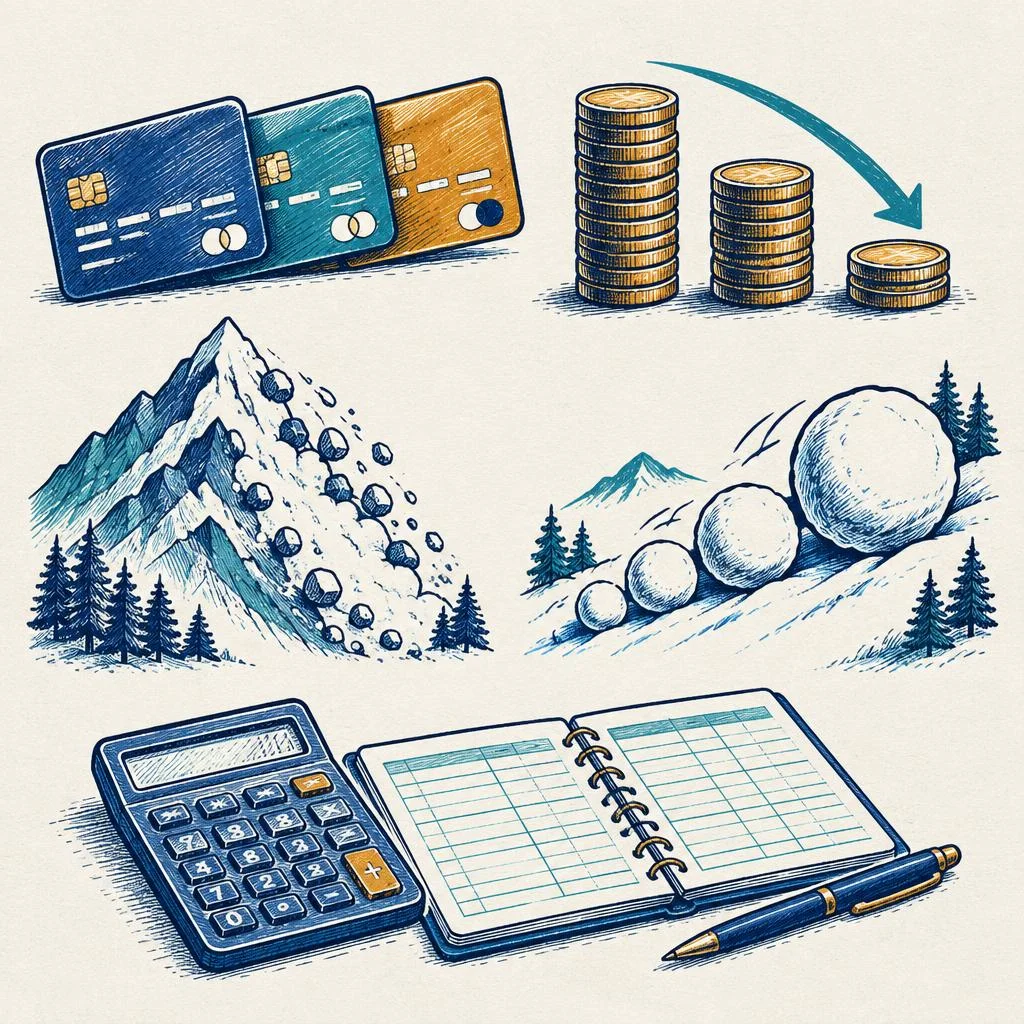 FinancialDebt avalanche vs snowball: a real payoff comparisonCompare independently calculated multi-card payoff schedules, interest costs and closure dates under explicit monthly payment assumptions.14 November 2026 · 8 min read
 FinancialCompound interest: three real savings scenariosThree practical savings examples show what comes from your deposits, what comes from growth, and which assumptions deserve scrutiny.14 November 2026 · 7 min read
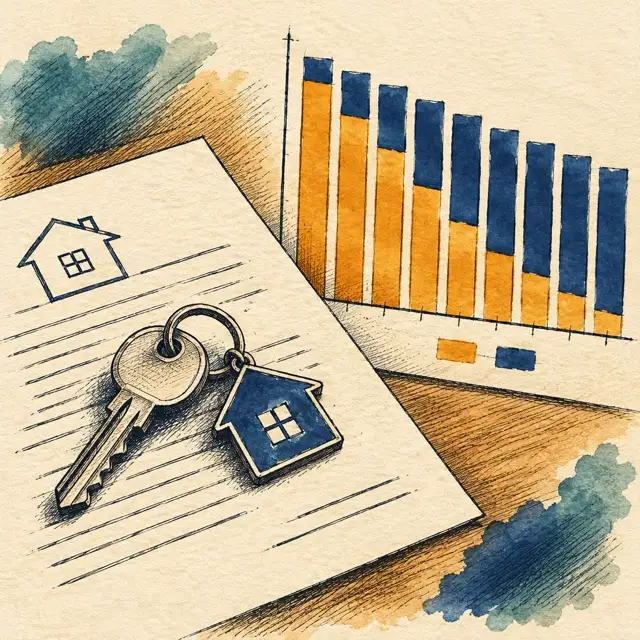 FinancialHow mortgage amortization really worksEarly payments are mostly interest because the balance is still large—not because the lender charges all the interest upfront.14 November 2026 · 7 min read
Sources and standards
About the author
Dr. Hassan Khames Eliwa holds a PhD in Construction & Built Environment and has more than 20 years of international project controls experience. He is Director of Eliwa Project Controls Limited in Auckland and founder of PMMilestone.org and PMMilestone.com.
Buy me a coffee