Age Calculator
This age calculator measures the calendar interval between a birth date and an as-of date, showing years, months and days. It also counts total days and whole weeks lived and finds the next birthday using a stated leap-day convention.
By Dr. Hassan Khames EliwaLast updated
Result
- Total days
- 13,304
- Total weeks
- 1900 weeks, 4 days
- Next birthday
- 2027-06-15
- Birthday countdown
- 210 days
How it works
Calendar age is not days divided by 365
A year may contain 365 or 366 days, and a month may contain 28, 29, 30 or 31. Dividing a day count by 365 therefore cannot reliably tell you whether someone has reached a birthday. Calendar age here starts with whole months from the birth date, then measures the remaining days after that monthly anniversary.
The monthly anniversary uses the original day of birth whenever that day exists. If it does not, the anniversary is clamped to the final day of that month. For someone born on January 31, one month later is February 28 in a common year. Adding months is always anchored to the original birth date, not repeatedly advanced from the previous shortened month.
Dates rather than timestamps
Both inputs represent civil dates. The calculation treats each date as midnight UTC and measures day differences in units of 86,400,000 milliseconds. This avoids daylight-saving changes turning a date interval into a fractional number of days. It does not calculate the precise number of seconds since delivery or adjust for the time zone in which someone was born.
The birth date must be real and no later than the as-of date. The as-of date may be historical or future: it is the reference point for every result, not necessarily the day you open the page.
Birthday policy
The birthday countdown is zero when the as-of date is the observed birthday itself. February 29 birthdays are observed on February 28 in non-leap years here. That is a calculation convention, not a statement about legal age rules, which can depend on the jurisdiction and purpose.
Worked example
A birthday later in the year
Use a birth date of 1990-06-15 and an as-of date of 2026-11-14. There are 436 completed calendar months between the dates, producing 36 years, 4 months and 30 days. The next monthly anniversary, November 15, has not yet been reached. This distinction is why subtracting the month numbers alone is unreliable.
The total elapsed interval is 13,301 days, equivalent to 1,900 weeks and 1 day. The next birthday is 2027-06-15, with 213 days remaining. These are elapsed-day counts: the birth date itself starts at zero, rather than being counted as a full day lived.
Expert tips
Common mistakes
- Reading total weeks as rounded weeks. The displayed count is whole weeks plus leftover days. One day short of a week remains six days, not another completed week.
- Adding one day automatically. Age is elapsed time, not an inclusive count of date labels. A newborn has zero completed days on the birth date.
- Treating the result as a birth-time measurement. Two people born on the same date receive the same output here, regardless of the hour or place of birth.
Frequently asked questions
Can I calculate age on a future date?
Yes. Enter the future date as the as-of date. That date becomes the reference for calendar age, total elapsed days and the birthday countdown.
How are February 29 birthdays handled?
Monthly anniversaries are clamped to the last available day. In non-leap years the birthday countdown therefore uses February 28; confirm legal requirements separately.
Why does a month not equal 30 days?
Calendar months have different lengths. Whole calendar months are counted first; the remaining days are actual elapsed days.
Does today depend on my location?
The form supplies the default date, but the calculation itself only uses the two entered date strings. For reproducible results, enter the desired as-of date explicitly.
Can I count an inclusive date range instead?
Use the date difference calculator and select its include-end option. Inclusive counting answers a different question from chronological age.
Related calculators
Related guides
 MathPercentages people get wrong: change, difference and pointsThe denominator determines the answer. Learn to distinguish percentage change, symmetric difference and percentage-point movements.14 November 2026 · 7 min read
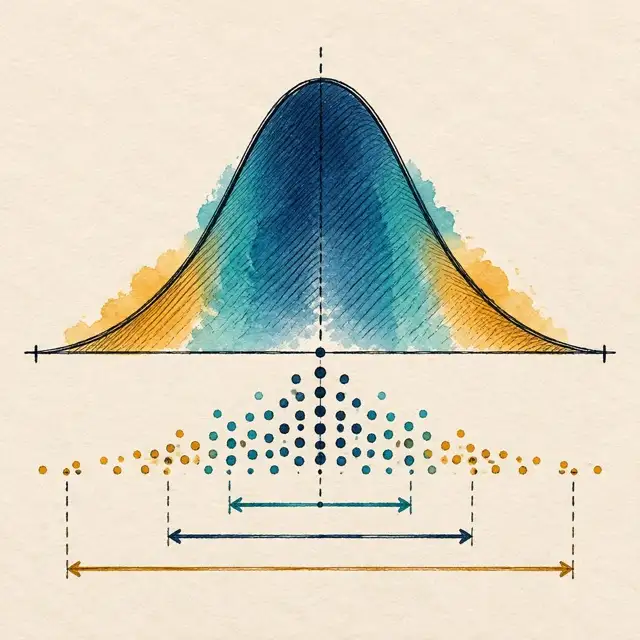 MathStandard deviation without the jargonThe average tells you the centre. Standard deviation helps describe the spread, provided you know what the data represents.14 November 2026 · 7 min read
Sources and standards
About the author
Dr. Hassan Khames Eliwa holds a PhD in Construction & Built Environment and has more than 20 years of international project controls experience. He is Director of Eliwa Project Controls Limited in Auckland and founder of PMMilestone.org and PMMilestone.com.
Buy me a coffee