
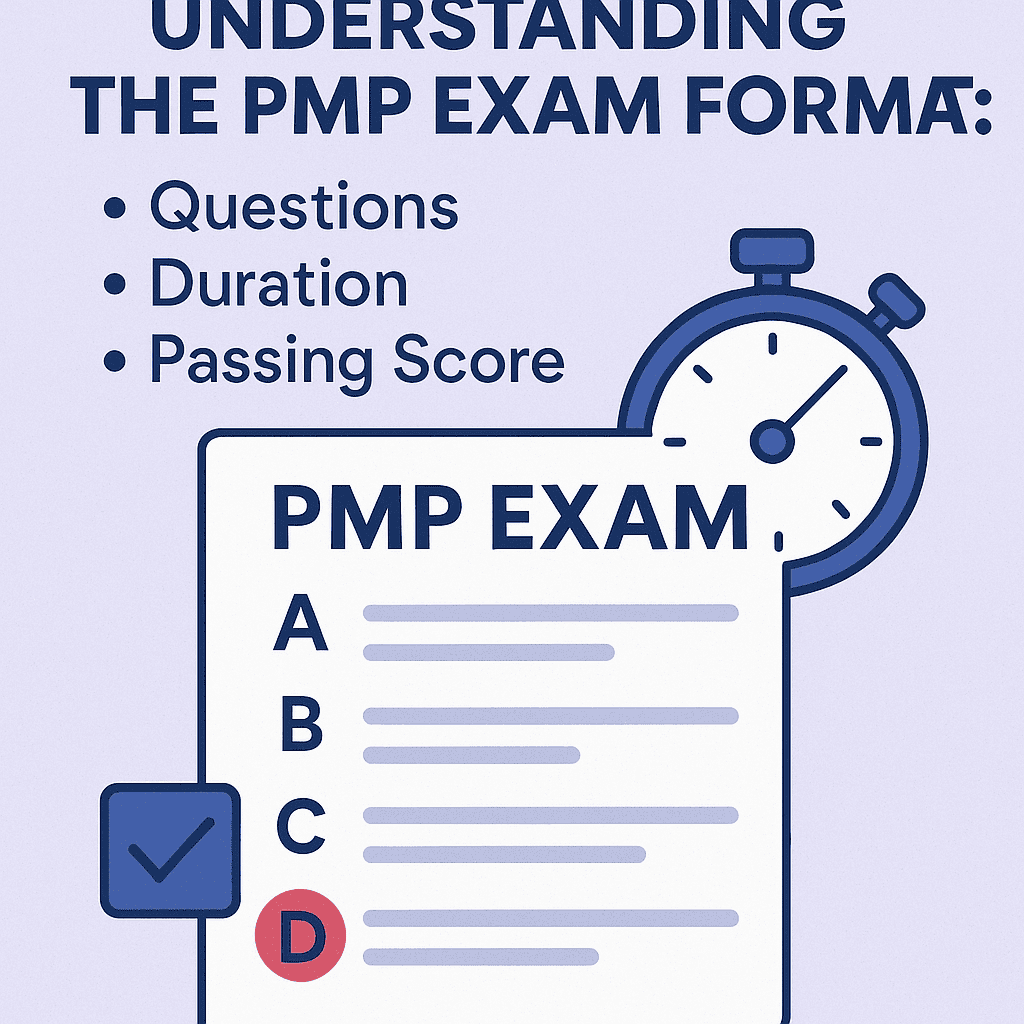
The PMP exam is a sought-after credential for project managers. Understanding its format is crucial for effective preparation. Let’s delve into what you need to know about the exam questions, duration, and passing score.
Exam Questions
The exam consists of 180 questions, but only 175 of them contribute to your score. The remaining five questions are pre-test questions that don’t affect your passing score; they serve to help develop future tests.
Here’s how the questions are structured:
- Multiple-Choice: Most of the questions require you to select one correct answer from four options. This tests your understanding of project management concepts, methodologies, and tools.
- Multiple Responses: A few questions might ask you to choose two or more correct answers, which tests your ability to analyze various aspects of project management.
- Fill-in-the-Blank: Rarely, a question may require you to fill in a specific term or phrase. This can often test specialized knowledge.
Consider this example:
Question: Which of the following processes belongs to the Executing process group?
- Develop Project Charter
- Manage Team
- Control Quality
- Define Activities
Correct Answer: 2. Manage Team
Tip: Familiarize yourself with the PMI Talent Triangle and how it relates to your exam preparation.
Exam Duration
The exam is designed to be completed in four hours. So, you have to manage your time efficiently. Here’s a breakdown of how you can allocate your time:
- Overview: Take the first 5-10 minutes to skim through all questions.
- Time per Question: Aim to spend roughly 1-2 minutes on each question.
- Review: Use the final 15-20 minutes to review flagged questions.
Example Calculation:
- Total Questions: 180
- Total Time: 240 minutes
- Time per Question: 240 minutes / 180 questions = approximately 1.33 minutes per question
Passing Score
One of the most frequently asked questions is about the passing score. The passing mark for the PMP exam is not fixed. The score is determined by a psychometric analysis conducted periodically by PMI based on the exam’s difficulty level.
However, the common estimate is that you’ll need to correctly answer about 61% to 75% of the questions to pass. This may vary depending on the exam version you take.
Exam Breakdown by Domain
The exam is divided into different domains:
| Domain | Percentage of Questions |
|---|---|
| People | 42% |
| Process | 50% |
| Business Environ. | 8% |
Case Study: Sarah, a project manager at a tech firm, decided to take the PMP exam after leading several successful projects. She focused her study on the “People” domain, understanding it comprises a significant portion of the exam. After practicing with tools and exam simulations, she found herself well-prepared, scoring above 80%.
Study Tools and Resources
To tackle the PMP exam effectively, a blend of books, online courses, and practice exams is essential. Here are some resources that may aid in your journey:
-
PMP Exam Prep Books: Invest in recommended books that provide exam strategies and sample questions.
-
PMP Exam Simulation Software: These tools can simulate real exam conditions and help fine-tune your pace.
-
Online Courses: Many platforms offer structured courses that explain PMBOK concepts in detail.
Frequently Asked Questions (FAQs)
Q1: What is the passing score for the PMP exam?
A1: The passing score is not explicitly defined but generally falls between 61% and 75% of correct answers.
Q2: How long do I have to complete the exam?
A2: You have four hours to complete all 180 questions.
Q3: Are all questions scored?
A3: No, only 175 out of the 180 questions are scored. The other 5 are pre-test questions.
Q4: How many domains are covered in the exam?
A4: The exam includes three main domains: People, Process, and Business Environment.
Q5: What types of questions can I expect?
A5: The questions mainly feature multiple-choice and may occasionally include multiple responses or fill-in-the-blank formats.
Conclusion
Successfully passing the PMP exam requires a solid understanding of its format, questions, duration, and scoring. Being aware of these elements can transform your study strategy and boost your confidence as you embark on this significant milestone in your project management career. Remember to utilize the various tools and resources available to make your journey smoother. Good luck! 🍀