TDEE and macros: build an adjustable nutrition plan
Estimate daily energy needs, translate calories into protein, fat and carbohydrate, and adjust from real trends rather than false precision.
By Dr. Hassan Khames EliwaLast updated
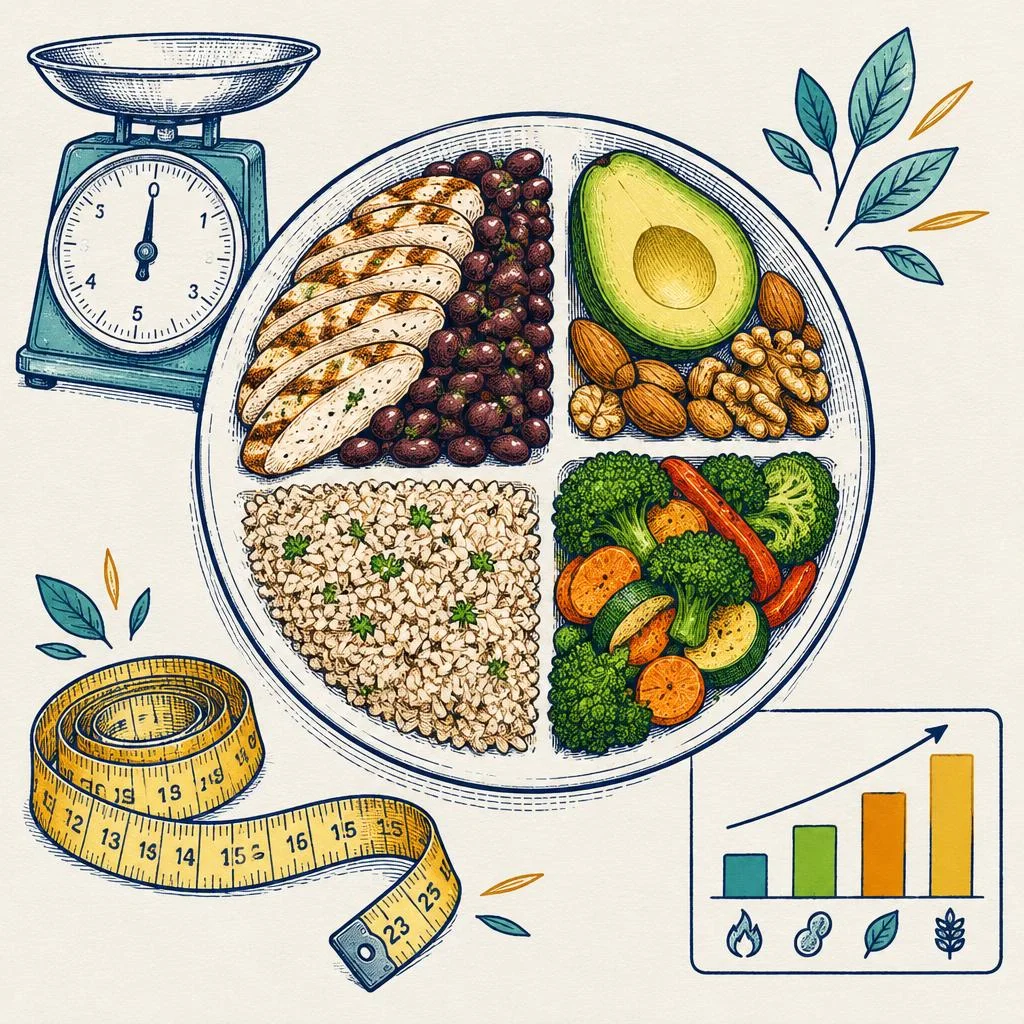
Treat the first calorie target as a hypothesis
Total daily energy expenditure, or TDEE, is the energy your body uses across a day, including resting metabolism, food processing, movement and exercise. A calculator estimates it from body measurements and activity assumptions. Macro planning then divides a chosen calorie target among protein, fat and carbohydrate.
The useful output is a starting range you can evaluate, not a laboratory measurement of your metabolism. Daily activity is difficult to summarize, food records contain uncertainty and needs change as body weight or training changes.
Begin with the TDEE calculator, translate a selected intake with the macro calculator, and check a weight-based protein range with the protein calculator. Keep the assumptions consistent across all three so that the resulting plan describes one person and one goal.
Resting energy is not your whole day
A common starting equation is Mifflin–St Jeor, which estimates resting energy expenditure from weight in kilograms, height in centimetres, age in years and a sex-specific constant. The original study developed a predictive equation; it did not claim to measure every individual's needs exactly. 1
The familiar form is 10 × weight + 6.25 × height − 5 × age + s, using s = +5 for the male equation and s = −161 for the female equation. Calculators often label this BMR, though the original equation concerns resting energy expenditure and measurement conditions differ.
For a 35-year-old man weighing 80 kg and standing 180 cm, the estimate is 800 + 1,125 − 175 + 5 = 1,755 kcal/day. This is a resting estimate, not a recommended intake and not an exercise allowance.
The sex constants reflect the population and structure of the equation. They do not capture every body composition or hormonal situation. People for whom these categories fit poorly should treat either result cautiously and seek individualized advice when the decision is consequential.
Activity multipliers are broad assumptions
For this example, select an illustrative activity multiplier of 1.6. Estimated TDEE becomes 1,755 × 1.6 = 2,808 kcal/day. The multiplier represents the whole day's activity pattern; it is not a measurement derived from one gym session.
A desk-based worker training three times a week may still spend most waking hours sitting. Conversely, a physically demanding job may create high daily expenditure without formal exercise. Match the assumption to the full week, not to the hardest workout you remember.
| Assumed activity multiplier | Estimated daily expenditure |
|---|---|
| 1.4 | 2,457 kcal |
| 1.6 | 2,808 kcal |
| 1.8 | 3,159 kcal |
The 702-calorie difference between the low and high scenarios is much larger than a small rounding adjustment. That is why a maintenance estimate of “2,808” should not imply accuracy to the nearest calorie.
Choose an intake you can evaluate
Suppose this adult chooses a modest illustrative reduction of 300 kcal/day, giving an intake target of 2,508 kcal/day. This is an arithmetic scenario for a generally healthy adult, not a universal recommendation or a guaranteed weight-loss rate.
A calorie deficit may support weight loss over time, but the relationship is dynamic. Body mass, spontaneous activity and expenditure can change. The NIH NIDDK Body Weight Planner explicitly models changing energy needs when planning weight change and maintenance. 2
Do not turn a fixed calorie gap into a promise that the scale must drop by a particular amount every week. Water, glycogen, digestive contents and menstrual-cycle effects can mask or amplify short-term changes.
For weight maintenance, the same process starts near estimated TDEE and checks the trend. For muscle gain, an appropriate plan also depends on training quality, experience and recovery. More calories alone do not guarantee more muscle.
Set protein in grams before choosing percentages
For an exercising adult, the International Society of Sports Nutrition position stand describes approximately 1.4–2.0 grams of protein per kilogram per day as sufficient for most exercising individuals, while noting that needs depend on the context. It is not a blanket prescription for everyone. 3
At 80 kg, that range is 112–160 grams/day. Our worked plan selects 1.6 g/kg, or 128 grams/day. Using the conventional 4 kcal per gram, that contributes 512 kcal.
A percentage-only target can behave oddly when calorie intake changes. At very low intake it may provide too little protein; at very high intake it may produce more than is useful for the person. A weight-based cross-check keeps the goal connected to its purpose.
People with kidney disease or other conditions affecting protein needs should seek clinician or dietitian guidance rather than adopting an athletic range from an article. Higher intake is not automatically better, and supplements are not required simply because a target is expressed in grams.
Allocate fat, then use carbohydrate as the remainder
For transparent arithmetic, choose 68 grams of fat in this example. At 9 kcal per gram, fat contributes 612 kcal. That is about 24.4% of the 2,508-calorie target.
Calories remaining for carbohydrate are 2,508 − 512 − 612 = 1,384 kcal. At 4 kcal per gram, carbohydrate is 346 grams.
| Macronutrient | Daily grams | Energy calculation | Daily calories |
|---|---|---|---|
| Protein | 128 g | 128 × 4 | 512 |
| Fat | 68 g | 68 × 9 | 612 |
| Carbohydrate | 346 g | 346 × 4 | 1,384 |
| Total | — | 512 + 612 + 1,384 | 2,508 |
These numbers reconcile exactly under the conventional factors. They are one allocation, not the ideal distribution for every sport, preference or medical situation. Food labels may not reconcile perfectly because of rounding, fiber, sugar alcohols and other labeling conventions.
Carbohydrate can support training, while fat contributes essential fatty acids and helps make meals practical. Neither nutrient should be treated as merely an obstacle to reaching a protein number.
Make the plan edible and repeatable
A daily target is not a meal plan. Spread protein across meals in a way you can sustain, include varied fruit and vegetables, choose fiber-containing carbohydrate sources and include suitable unsaturated-fat sources. Consider allergies, cost, cultural preferences and cooking access.
For example, 128 grams of protein could be spread across four eating occasions averaging 32 grams. That is a scheduling illustration rather than a requirement that every meal contain exactly the same amount.
Liquid calories, cooking oils and weekend meals can materially change average intake. Record them consistently when evaluating the estimate. Avoid compensating for uncertain tracking by making an unnecessarily restrictive target even lower.
Calibrate using several weeks, not one weigh-in
If weighing is appropriate for you, measure under comparable conditions and compare multi-day averages over several weeks. Also consider hunger, training performance, sleep and recovery. A scale trend is one input, not a complete health assessment.
When the trend differs from the goal, first check consistency and changes in activity. If an adjustment is appropriate, change one thing modestly and observe again rather than rewriting calories, workouts and meal timing simultaneously.
Re-estimate after meaningful changes in weight, training volume or daily work. Consumer trackers and formulas can help organize observations, but neither should override persistent fatigue, dizziness or declining health.
Know when generic targets are the wrong tool
Children, pregnant or breastfeeding people, adults recovering from illness and people with a history of disordered eating need more individualized support than this example provides. Athletes with demanding training schedules may also need specialist assessment of energy availability.
If calorie counting increases anxiety or compulsive behavior, step back and discuss another approach with an appropriately qualified professional. The purpose of an estimate is to support nourishment and practical decisions, not to create a daily pass-or-fail score. Keep the calculations adjustable, and let sustained evidence and wellbeing matter more than the apparent precision of the first result.
Calculators used in this guide
Frequently asked questions
Is TDEE the same as BMR?
No. Resting metabolism is only one component. TDEE also includes activity, exercise and the energy used to process food.
Should I eat back all exercise calories?
Not automatically. If the activity factor already includes exercise, adding those calories again can double-count it. Tracker estimates also have uncertainty.
Do the example macros add up exactly?
Yes. Protein contributes 512 calories, fat 612 and carbohydrate 1,384, totaling 2,508 under the conventional 4/9/4 calorie factors.
Is 1.6 grams of protein per kilogram required for everyone?
No. It is an illustrative choice within an exercising-adult range. Age, goals, training and medical circumstances can change appropriate needs.
How soon should I change my calorie target?
Avoid reacting to one weigh-in. Review consistent intake, activity and trends over several weeks when appropriate, and seek professional help for symptoms or special health needs.
Sources and standards
About the author
Dr. Hassan Khames Eliwa holds a PhD in Construction & Built Environment and has more than 20 years of international project controls experience. He is Director of Eliwa Project Controls Limited in Auckland and founder of PMMilestone.org and PMMilestone.com.
Buy me a coffee