




Understanding the Critical Path Method in Project Scheduling
The Critical Path Method (CPM) is a key technique in project management used to identify the essential tasks that determine the project’s duration. It helps project managers visualize the sequence of tasks, identifying which ones are critical for timely completion and which have some flexibility in scheduling. Let’s break down the concepts and applications of CPM.
What is the Critical Path?
The critical path is the longest stretch of dependent activities in a project. It dictates the shortest time in which the project can be completed. Recognizing the critical path allows us to prioritize and allocate resources more effectively.
How to Identify the Critical Path
To identify the critical path, you need to:
- List all Activities: Start by mapping out all project activities and tasks you need to complete.
- Determine Durations: Estimate the time required to complete each task.
- Identify Dependencies: Determine which tasks depend on others before they can start.
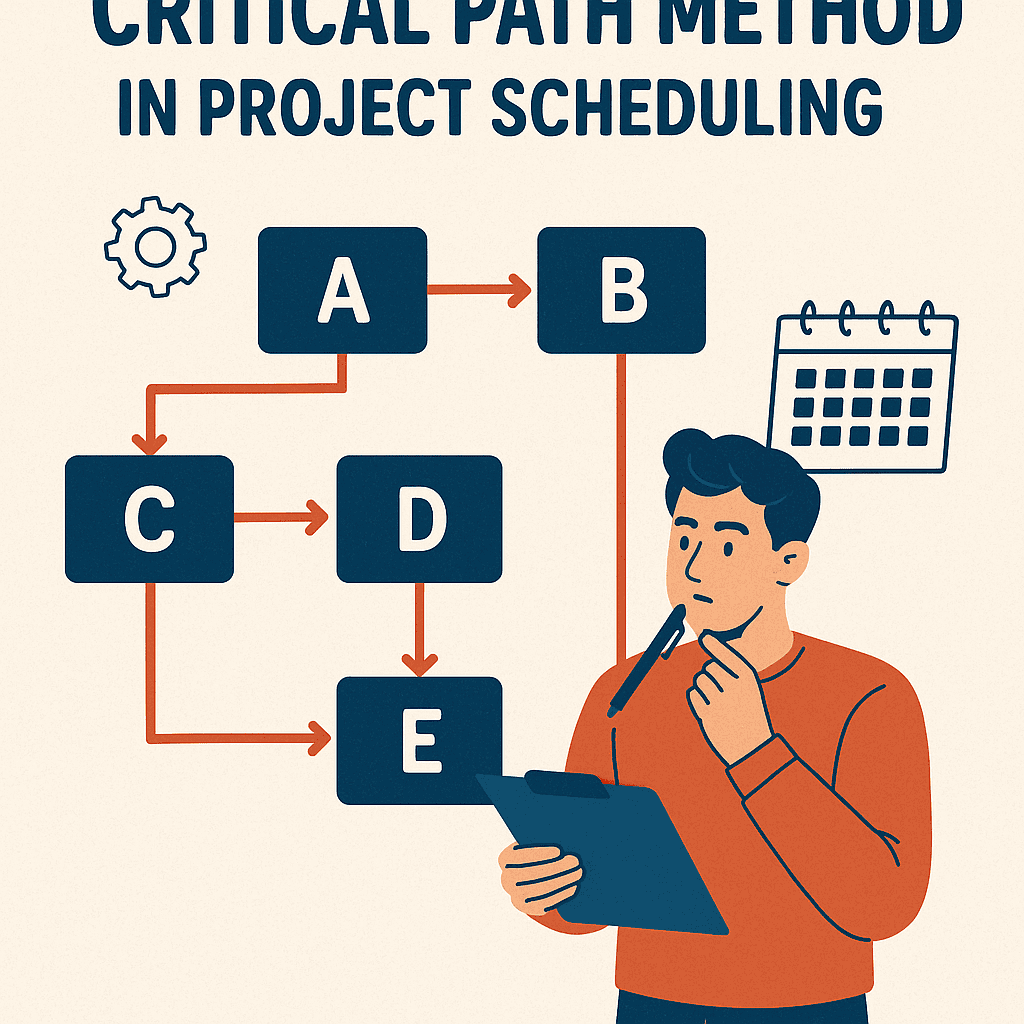
- Create a Project Network Diagram: Visualize tasks, durations, and dependencies in a flowchart format.
- Calculate the Longest Path: From the network diagram, calculate the path that consumes the most time — that’s your critical path.
Here’s a simple example to illustrate:
| Task | Duration | Predecessors |
|---|---|---|
| A | 4 days | – |
| B | 3 days | A |
| C | 5 days | A |
| D | 2 days | B, C |
| E | 1 day | D |
In this case, the critical path would be A → C → D → E, with a total duration of 4 + 5 + 2 + 1 = 12 days.
Using CPM for Effective Management
CPM aids in providing a realistic timeline and resource allocation. It also helps in risk management. By knowing the critical tasks, you can focus on minimizing delays or allocating extra resources to avoid impacting the project timeline.
Case Study: Building a Community Center
Imagine a project that aims to build a community center. The involved tasks include site preparation, building the structure, electrical installations, and landscaping. Following the CPM approach, the project manager lays out the activities:
- Site Preparation (A): 10 days
- Construction (B): 30 days (depends on A)
- Electrical (C): 15 days (depends on B)
- Landscaping (D): 5 days (depends on C)
The critical path here is A → B → C, with a total duration of 10 + 30 + 15 = 55 days. The landscaping can be delayed without affecting the overall timeline, thus offering some flexibility for the project manager.
The Importance of Slack Time
In CPM, slack (or float) time is the amount of time a task can be delayed without affecting the overall project timeline. Tasks along the critical path have zero slack time, while non-critical tasks may have some float. Knowing slack time can help project managers make decisions about reallocating resources or shifting timelines when necessary.
Benefits of CPM
- Clear Visualization: Provides a pictorial representation of the project timeline and dependencies.
- Focused Management: Empowers project managers to concentrate on critical tasks that impact completion.
- Resource Optimization: Allows better utilization of resources by identifying where efforts are most needed.
- Informed Decision-Making: Equips managers with vital information for risk assessment and resource allocation.
Limitations of CPM
Despite its benefits, CPM can have limitations. It assumes that project tasks are deterministic — each task has a fixed duration without accounting for uncertainties. If unexpected delays occur, CPM should be adjusted to reflect reality.
Tools for Implementing CPM
If you’re looking to implement the Critical Path Method in your projects, various tools can assist:
- Microsoft Project: A powerful tool for project management that includes CPM features. You can find out more about it here.
- Primavera P6: A project management software specifically designed for managing large projects.
- Trello: While not primarily a CPM tool, it can be adapted for visualizing project timelines.
You can explore project planning tools here.
FAQs
What is the primary purpose of the Critical Path Method?
The primary purpose is to determine the shortest possible duration for a project by focusing on critical tasks that affect overall completion time.
Can tasks on the critical path change during the project?
Yes, as project conditions evolve, tasks may change and consequently, the critical path may shift.
Is there a difference between CPM and PERT?
Yes, while CPM focuses on fixed time estimates, PERT (Program Evaluation Review Technique) deals with uncertain duration estimates and is often used for research and development projects.
How often should the critical path be monitored?
It’s good practice to monitor the critical path regularly, especially after any major project changes or unforeseen delays.
Do non-critical tasks impact the project’s completion time?
If non-critical tasks are delayed beyond their slack time, they can impact the completion of the project.
By understanding the Critical Path Method, project managers can streamline scheduling and enhance project delivery. It may involve some effort upfront to visualize and lay down the project tasks, but the immense benefits in planning and execution far outweigh any initial challenges. Remember, using CPM isn’t just a method — it’s a philosophy that can redefine project management’s precision and effectiveness.
Have fun with your projects, and may your paths always be clear! 🚀