The 50/30/20 budget and how big an emergency fund should be
Use percentages to start the conversation, then size your cash reserve around the bills that would survive an income shock.
By Dr. Hassan Khames EliwaLast updated
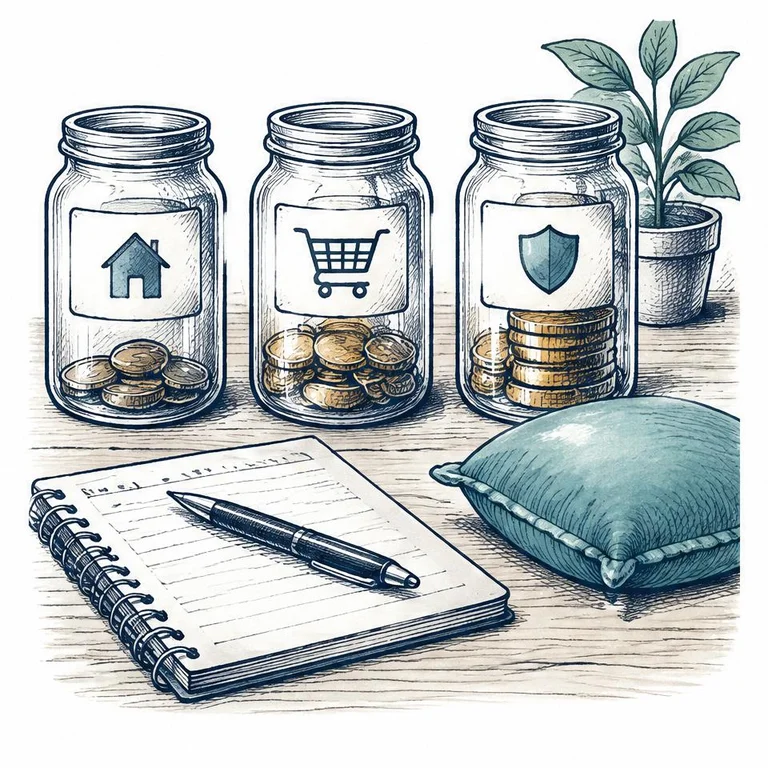
Give the budget and the emergency fund different jobs
A budget decides where this month's income goes. An emergency fund keeps an unexpected bill or interrupted paycheck from turning into expensive debt. They belong in the same plan, but they do not use the same denominator: the budget starts with take-home income, while the reserve starts with essential expenses.
The 50/30/20 framework assigns 50% of take-home pay to needs, 30% to wants, and 20% to savings and additional debt repayment. Treat those percentages as a diagnostic heuristic, not a universal standard of responsible spending. A household facing high rent, care costs or irregular earnings may need a very different allocation.
Use the 50/30/20 budget calculator to sketch the starting split. Then replace the tidy categories with actual bills before setting transfers or deciding that the plan is affordable.
Work from spendable income, consistently defined
Start with income after taxes. If retirement contributions, insurance or other benefits already come out of payroll, record them separately so the budget does not count the same saving or expense twice. A simple cash budget can use the amount deposited into checking, provided its categories consistently exclude those payroll deductions.
For variable earnings, avoid building recurring commitments around the best month. Use a cautious baseline supported by your records, then write a rule for allocating surplus months. A self-employed person's tax provision is not discretionary saving; money owed for taxes is already committed.
Here is a hypothetical household with $4,000 monthly take-home pay:
| Category | Starting share | Monthly allocation | Examples |
|---|---|---|---|
| Needs | 50% | $2,000 | Housing, basic food, required transport |
| Wants | 30% | $1,200 | Entertainment, upgrades, optional subscriptions |
| Savings and extra debt payments | 20% | $800 | Emergency cash, future goals, additional principal |
| Total | 100% | $4,000 | Every dollar has one assignment |
The arithmetic is $4,000 × 0.50 = $2,000, $4,000 × 0.30 = $1,200, and $4,000 × 0.20 = $800. These are planning allocations, not evidence that any particular household can meet its needs for $2,000.
Classify the obligation, not the merchant
A supermarket receipt may contain basic groceries and optional treats. A phone bill may cover essential service and a financed premium handset. Classifying the whole merchant as a need hides choices that might be adjustable during a difficult month.
Minimum required debt payments generally belong with obligations; payments above the minimum compete with other saving goals. Basic transport to work may be essential, while upgrading the vehicle is a separate choice. Use categories to identify decisions, not to judge every purchase.
Annual insurance renewals, routine servicing and holiday spending are predictable even when they are not monthly. Divide the expected annual cost by twelve and fund a separate sinking fund. An irregular due date does not make a known expense an emergency.
When needs exceed half of income
Suppose the same household's actual essentials are $2,500 per month. Needs now consume 62.5% of its $4,000 income. Insisting on both $1,200 of wants and $800 of savings would create a $500 shortfall: total planned spending would be $4,500.
One possible temporary allocation is $2,500 needs, $700 wants and $800 savings or extra debt payments. That is 62.5%, 17.5% and 20%, respectively. It balances arithmetically, but only the household can decide whether the categories are realistic.
If even essential spending exceeds income, percentage adjustments cannot solve the cash gap. Examine benefits, hardship arrangements, housing or transport alternatives, and credible debt support. Avoid presenting an unattainable savings percentage as a failure of discipline.
A useful monthly review asks two questions: did the plan balance, and did it reflect what actually happened? A budget that repeatedly needs emergency withdrawals for groceries has probably understated ordinary costs.
Size the reserve from a stripped-back monthly budget
An emergency fund commonly aims to cover several months of essential expenses. Three to six months is a useful starting range, not a promise of adequacy or a requirement to delay all other goals until it is reached.
Build the essential-cost figure from housing, basic utilities, groceries, necessary insurance, minimum debt payments, essential transport and unavoidable care costs. Consider what changes after an income loss. Commuting might fall, but replacing employment-linked insurance could increase costs. Do not automatically assume every current expense disappears.
For the hypothetical household with $2,500 monthly essentials:
| Coverage target | Calculation | Reserve target |
|---|---|---|
| Three months | $2,500 × 3 | $7,500 |
| Six months | $2,500 × 6 | $15,000 |
Use the emergency fund calculator to compare coverage periods against your own essential budget. Do not substitute the earlier $2,000 guideline allocation when actual essentials are $2,500; that would understate the reserve requirement.
Choose the coverage period deliberately
A household with stable independent incomes, flexible expenses and reliable insurance may choose a smaller buffer than someone with seasonal work, dependants or a long expected job search. Two earners working for the same employer or industry may have correlated risks rather than genuine diversification.
List the shocks the reserve must handle: an income interruption, a necessary repair, a deductible, or an urgent trip. Insurance can limit some large losses, but deductibles, exclusions and claim delays still matter. Available credit is not equivalent to cash because limits, costs and eligibility can change.
Do not simply add every imaginable loss into one enormous target. Separate likely short-term cash needs from risks better managed through insurance, contractual protections or reduced fixed commitments. Record why the selected target fits, then revisit it after a move, new dependant or employment change.
Turn the target into a monthly transfer
An intimidating target becomes more useful when translated into a contribution. Suppose the household already has $1,500 reserved and wants the three-month target of $7,500. The remaining gap is $6,000.
At $500 per month, closing that gap takes 12 months, assuming no interest, withdrawals or missed contributions. At $800 per month, the arithmetic is 7.5 contributions, so eight monthly deposits are needed if deposits occur only once each month. Reduce the final deposit to the remaining balance rather than accidentally overcommitting that month's cash.
The savings goal calculator helps compare a deadline with an affordable contribution. State whether interest is included. For a short-term reserve, a plan that works without assumed earnings is easier to monitor and less dependent on a changing deposit rate.
If $800 is the entire saving-and-extra-debt category, sending all of it to emergency cash leaves nothing there for other goals. Explicitly divide that amount rather than allocating the same dollars to both retirement and the reserve.
Keep the money accessible and the rules simple
An emergency reserve needs liquidity and capital stability more than a high expected return. A separate deposit account can reduce accidental spending; check applicable deposit protection, withdrawal access, fees and minimum balances in your jurisdiction. Investments that can fall sharply are a poor match for a bill due tomorrow.
Define a withdrawal rule before the stressful moment. Ask whether the cost is necessary, genuinely unplanned and urgent enough that waiting would cause harm. A scheduled annual premium belongs in its sinking fund, while a sudden essential repair may justify emergency cash.
Reconcile the budget monthly and review essential expenses periodically. The useful outcome is not a perfect pie chart. It is a repeatable system that pays current obligations, distinguishes foreseeable bills from shocks, and makes the next financial decision visible.
Calculators used in this guide
Frequently asked questions
Is the 50/30/20 budget a strict rule?
No. It is a starting framework for discussing trade-offs. High essential costs, low income, debt obligations and irregular earnings can justify different percentages. A workable budget must balance using actual costs.
Should the emergency fund cover income or expenses?
Base the target on essential expenses during a disruption, not total income. Include unavoidable bills and consider costs that might change after losing work, such as transport or insurance.
Do retirement investments count as emergency cash?
Usually keep them separate in this plan. Access restrictions, taxes, penalties and market movements may prevent retirement investments from meeting an immediate bill without significant cost.
Should debt repayment come before the emergency fund?
There is no single sequence for every household. Maintain required payments, consider a starter cash buffer, and compare expensive debt with liquidity needs and any relevant employer benefits before allocating additional money.
How often should the target change?
Review it when essential bills, dependants, insurance or income stability change. Recalculate after a major withdrawal and make a specific replenishment plan rather than assuming the balance will recover automatically.
Sources and standards
About the author
Dr. Hassan Khames Eliwa holds a PhD in Construction & Built Environment and has more than 20 years of international project controls experience. He is Director of Eliwa Project Controls Limited in Auckland and founder of PMMilestone.org and PMMilestone.com.
Buy me a coffee