Present and future value: move money through time
Understand discounting and compounding, compare dated cash flows, and keep nominal rates, inflation and payment timing consistent.
By Dr. Hassan Khames EliwaLast updated
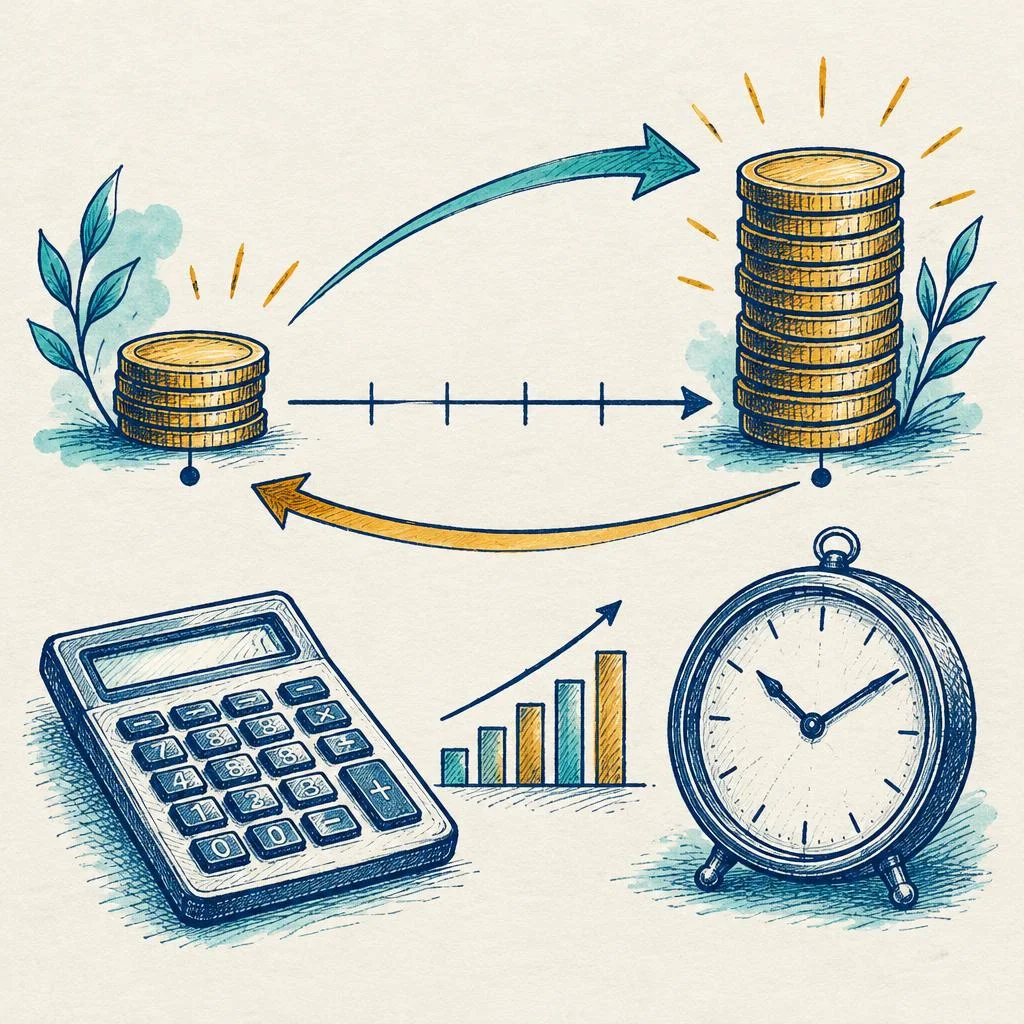
A dollar amount needs a date
Future value projects money forward using an assumed compound growth rate. Present value discounts a future amount back to an equivalent amount today using a chosen rate. They are inverse operations when the cash flow, timing and rate assumptions match.
That sounds abstract until a decision presents two dates: pay a supplier now or later, set aside money for an equipment replacement, or compare a lump sum with a future payment. Comparing the printed amounts alone ignores the time between them.
Use the present value calculator to translate a future target into today's equivalent. Use the future value calculator to project today's principal or a supported contribution schedule forward. Before entering numbers, write down what the rate represents and when each cash flow occurs.
The single-sum relationship
For a constant rate per period, future value is FV = PV × (1 + i)^n. Present value is PV = FV / (1 + i)^n. Here i is the rate per compounding period and n is the number of those periods.
The compound-interest and present-value relationships are standard time-value-of-money formulas explained in OpenStax's compound interest material. The scenarios in this article are illustrative calculations, not return forecasts. 1
Suppose $10,000 remains invested for ten years at an assumed effective annual rate of 5%, with no deposits, withdrawals, taxes or fees. Future value is 10,000 × 1.05^10 = $16,288.95, rounded only at the end.
The increase of $6,288.95 includes interest on prior interest. Simple interest would produce $10,000 × (1 + 0.05 × 10) = $15,000, which is a different model.
Read the growth rather than just the endpoint
| Year | Value at 5% annual compounding |
|---|---|
| 0 | $10,000.00 |
| 1 | $10,500.00 |
| 2 | $11,025.00 |
| 5 | $12,762.82 |
| 10 | $16,288.95 |
The first year's gain is $500. The second year's gain is $525 because the opening balance now includes the first year's interest. The assumed rate is constant, but the dollar gain grows with the balance.
Market investments do not usually deliver a smooth 5% each year. A deterministic compound calculation is a scenario under a specified rate, not evidence that an investment will follow this path. Volatility, losses and the timing of withdrawals can materially change real outcomes.
Work backward from a future bill
Suppose an equipment replacement is expected to require $20,000 in ten years. At a chosen annual discount rate of 5%, its present value is 20,000 / 1.05^10 = $12,278.27.
This says that $12,278.27 today grows to approximately $20,000 under the same smooth 5% assumption, subject to cent rounding. It does not say the equipment seller will accept that amount now or that a safe investment yielding 5% is available.
The discount rate expresses a valuation assumption. Depending on the question, it may represent an opportunity cost, a required return or an appropriate rate for a particular risk. A high discount rate makes a distant receipt less valuable today; it does not make a future obligation disappear.
Test sensitivity before deciding
The same $20,000 due in ten years has different present values under different annual rates:
| Annual discount rate | Present value |
|---|---|
| 0% | $20,000.00 |
| 3% | $14,881.88 |
| 5% | $12,278.27 |
| 7% | $10,166.99 |
The spread is substantial because the assumption compounds over ten years. Selecting a discount rate just to justify a preferred answer reverses the analysis. Start with the economic question and the risk of the cash flow, then examine plausible rates.
For uncertain receipts, consider whether the promised amount itself is realistic. Discounting a highly doubtful payment at an arbitrary rate may conceal more than it reveals. Credit risk and timing uncertainty deserve explicit treatment.
Match the rate to the period
A nominal annual rate of 6% compounded monthly means a monthly rate of 0.06 / 12 = 0.5%. Over ten years there are 120 monthly periods. The effective annual rate is (1.005)^12 − 1, approximately 6.1678%.
A stated effective annual rate of 6% is different. Its equivalent monthly rate is 1.06^(1/12) − 1, approximately 0.4868%, not 0.5%. Dividing an effective annual rate by twelve overstates the monthly rate.
The distinction becomes important for long horizons or frequent contributions. It also explains why two calculators can disagree despite displaying “6%” if one expects a nominal rate and the other an effective annual rate.
Never enter 5 when a formula expects 0.05. A calculator field labeled as a percentage may perform that conversion for you, but the underlying formula still uses a decimal rate.
Contributions introduce another clock
With regular contributions, each payment has its own growth period. For a month-end deposit P, monthly rate i and n deposits, an ordinary annuity's future value is P × ((1 + i)^n − 1) / i when i is nonzero.
For $200 deposited at the end of every month for 120 months at 0.5% monthly, future value is $32,775.87. Contributions total $24,000, leaving $8,775.87 of modeled growth. The final deposit earns no interest before the endpoint; the first earns 119 months.
If every deposit moves to the beginning of the month, multiply the unrounded ordinary-annuity result by 1.005. Future value becomes $32,939.75. That difference is entirely payment timing, not a higher contribution total.
At a zero rate, use contributions multiplied by the number of deposits. Do not force the annuity formula through division by zero. For irregular contributions, value each dated payment separately and add the results at a common date.
Separate nominal money from purchasing power
Nominal future value is measured in future dollars. Real value adjusts for inflation. If a portfolio earns 5% annually while prices rise 2.5%, the exact annual real rate is 1.05 / 1.025 − 1, approximately 2.4390%.
Subtracting the rates gives a rough approximation, but it is not the exact relationship. More importantly, do not discount inflation-adjusted cash flows with an unadjusted nominal rate. Both sides of the calculation must use a consistent money basis.
A $20,000 replacement estimate expressed in today's prices is not automatically a $20,000 bill ten years from now. Either inflate the expected bill and use a nominal discount rate, or keep the bill in today's purchasing power and use a real rate.
Compare alternatives at one valuation date
If a contract offers payment now or later, move both alternatives to the same date before comparing them. Include taxes, fees, default risk and any restrictions on access to the money. A headline yield may not be the spendable return.
For multiple cash flows, sum their present values rather than averaging their dates. Keep unrounded intermediate values and round the final reported money amount to cents. Then ask whether the difference is large enough to survive plausible changes in assumptions. The mathematics is exact for its inputs; the decision is only as strong as the cash-flow and rate judgments behind them.
Calculators used in this guide
Frequently asked questions
Are present value and future value opposites?
They are inverse operations for the same cash flow, rate and timing. Compounding moves forward; discounting moves backward.
Does a 5% calculation guarantee a 5% return?
No. It shows the result if the assumed rate applies. Investment outcomes, fees and taxes may differ from that scenario.
Can I divide any annual rate by twelve?
Only when converting a nominal annual rate quoted with monthly compounding. An effective annual rate requires an equivalent monthly-rate calculation.
Why do beginning-of-month contributions grow more?
Each receives one additional compounding period. Under constant monthly assumptions, multiply the ordinary-annuity future value by one plus the monthly rate.
Should I use real or nominal cash flows?
Either can be appropriate, but keep the rate consistent. Use nominal rates with nominal cash flows and inflation-adjusted rates with real cash flows.
Sources and standards
About the author
Dr. Hassan Khames Eliwa holds a PhD in Construction & Built Environment and has more than 20 years of international project controls experience. He is Director of Eliwa Project Controls Limited in Auckland and founder of PMMilestone.org and PMMilestone.com.
Buy me a coffee