Present Value Calculator
This calculator finds the value today of a single future payment by discounting it at a constant rate per period. Enter the future amount, periodic discount rate and number of periods; the result is the equivalent present lump sum under those assumptions.
By Dr. Hassan Khames EliwaLast updated
Result
- Future amount
- $10,000.00
- Periodic rate
- 5.00%
- Periods
- 10
How it works
Bring one future amount back to today
Present value answers a timing question: what amount today would grow into a specified later amount at the chosen rate? The calculation divides the future amount by a compound growth factor. It does not subtract the same percentage repeatedly from the future payment.
The rate belongs to one period, and the count tells the calculator how many of those periods pass before payment. A yearly rate needs a count in years. A monthly rate needs a count in months. Periods must be whole numbers here. Zero periods returns the future amount unchanged because there is no time over which to discount it.
Choose the rate for the decision
A discount rate expresses the return required to exchange money now for money later. For a contractual payment it may reflect an opportunity cost or a comparison yield. For a business forecast it may also reflect uncertainty. The calculator does not select a risk premium or determine whether a promised payment will actually arrive.
Use a nominal rate with a nominal future payment, or a real rate with a payment stated in today's purchasing power. Mixing those approaches can count inflation twice or ignore it. Likewise, use a rate after tax only when the cash-flow assumptions are on a compatible after-tax basis. A lower discount rate increases present value; a higher rate reduces it.
Keep the scope to a single lump sum
There are no recurring contributions, withdrawals or intermediate payments in this model. A stream of payments requires each cash flow to be discounted for its own timing and then added. Entering the total of several future payments as if all arrive on one date misstates their value.
Rates above negative one hundred percent are accepted, including negative rates. A negative rate can produce a present value larger than the future amount; that is a consequence of the input, not a guaranteed investment opportunity. Extreme combinations that cannot be represented reliably are rejected rather than shown as valid money values.
Worked example
Value a payment due in ten years
Suppose you expect $10,000.00 in ten annual periods and use a 5% annual discount rate. Divide $10,000 by 1.05 raised to the tenth power. The displayed present value is $6,139.13, with a periodic rate of 5.00% and 10 periods.
For a second comparison, enter a future amount of $12,100, a 10% rate and two annual periods. The growth factor is 1.21, giving a present value of $10,000.00. This is the amount that would grow to $12,100 under the stated rate and timing. Both examples use one payment at the end of the final period, not annual installments.
Expert tips
Common mistakes
- Dividing an effective annual rate automatically by twelve. The equivalent monthly rate is derived through compounding. Simple division is appropriate only when the quoted rate convention calls for it.
- Discounting money that is already stated as present value. Check the label on a quoted valuation before applying another discount factor to the same amount.
- Treating a promise as cash. Discounting models time and the selected return assumption; it does not independently measure default risk or establish the legal enforceability of a payment.
For education, not financial advice. Results are estimates based on the inputs you give. Lenders, tax authorities and advisers may use different rules, fees and rounding. Check the numbers with a qualified professional before you commit to anything.
Frequently asked questions
What does a zero discount rate do?
With a zero rate, present value equals the future amount for every accepted period count. You are assuming that waiting creates no required return or time-value adjustment.
Can the present value exceed the future amount?
Yes. A negative periodic rate above negative one hundred percent makes the discount factor smaller than one for positive periods, so the present amount is larger.
Does this calculate an annuity?
No. An annuity has multiple scheduled payments. This calculator discounts one final lump sum; each annuity payment would need its own timing treatment.
Which rate should I enter for monthly periods?
Enter a rate that applies to one month. If you start with an effective annual rate, convert it to an equivalent monthly compound rate rather than assuming every annual quote uses the same convention.
Is the displayed value a market price?
Not necessarily. It is a mathematical equivalent under your inputs. Actual market prices can include liquidity, credit, taxes and contractual features that are absent from this calculation.
Related calculators
Related guides
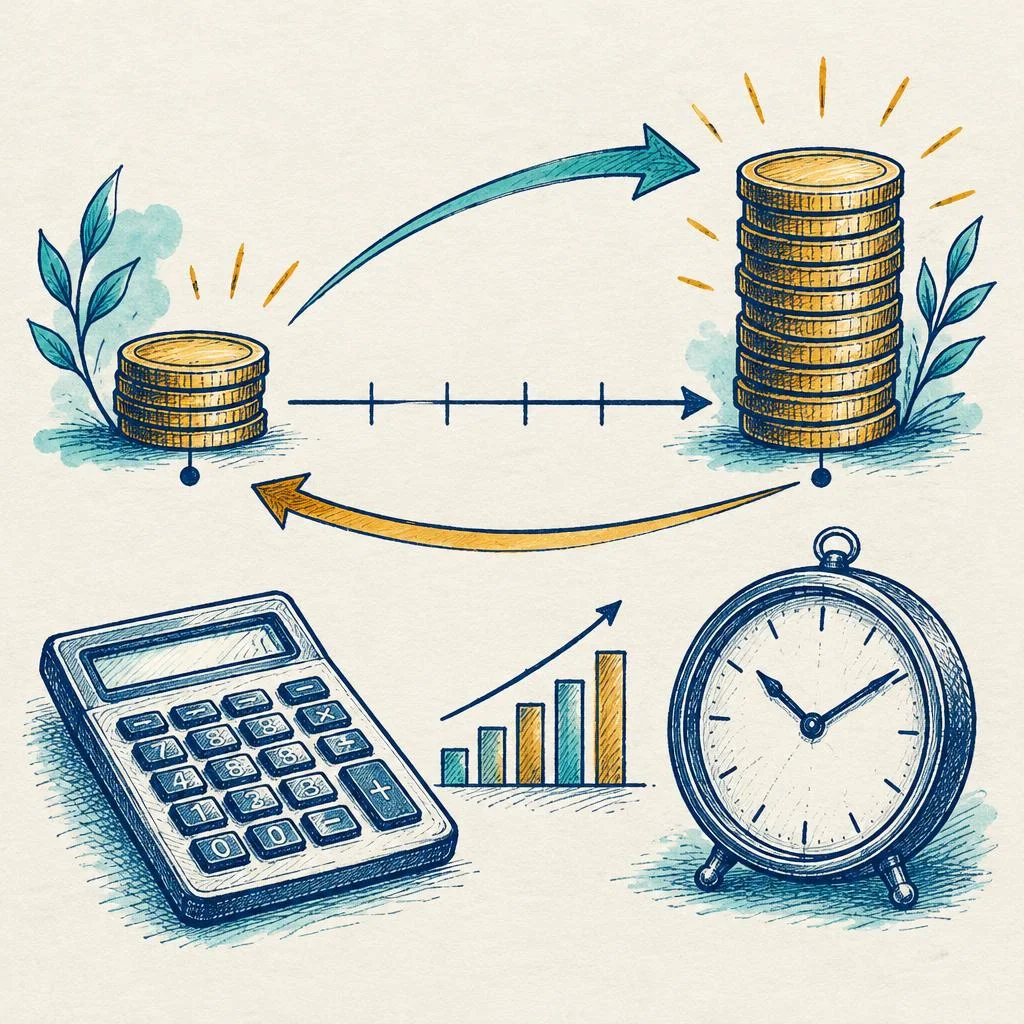 FinancialPresent and future value: move money through timeUnderstand discounting and compounding, compare dated cash flows, and keep nominal rates, inflation and payment timing consistent.14 November 2026 · 8 min read
 FinancialMargin vs markup: the pricing mistake that eats profitA percentage added to cost is not the same percentage retained from sales. That denominator mistake can quietly undermine a pricing plan.14 November 2026 · 7 min read
 FinancialCompound interest: three real savings scenariosThree practical savings examples show what comes from your deposits, what comes from growth, and which assumptions deserve scrutiny.14 November 2026 · 7 min read
About the author
Dr. Hassan Khames Eliwa holds a PhD in Construction & Built Environment and has more than 20 years of international project controls experience. He is Director of Eliwa Project Controls Limited in Auckland and founder of PMMilestone.org and PMMilestone.com.
Buy me a coffee