NPV Calculator
This NPV calculator discounts a sequence of periodic cash flows and subtracts the upfront investment. Enter the required return per period to see whether the forecast receipts compensate for both the initial spending and the timing of the money.
By Dr. Hassan Khames EliwaLast updated
Result
- Present value of future cash flows
- $10,413.22
- Discount rate per period
- 10.00%
- Initial investment$10.0k
- Future cash flow PV$10.4k
End-of-period discounted cash flows
| Period | Cash flow | Present value |
|---|---|---|
| 1 | $6,000.00 | $5,454.55 |
| 2 | $6,000.00 | $4,958.68 |
How it works
Give each payment its own date
Net present value puts future receipts and payments on the same valuation date as the initial investment. The initial investment happens now, at period zero, and is entered as a positive cost. The first amount in the cash-flow box happens at the end of period one. Subsequent amounts belong to consecutive, equally spaced periods; enter a zero when a period has no movement of cash.
The calculation is NPV = −initial investment + Σ[CFt ÷ (1 + r)^t]. Here CFt is the signed cash flow in period t and r is the discount rate expressed as a decimal. A positive future amount is a receipt; a negative amount is an additional payment. The separate present-value result is the sum before deducting the initial cost.
Match the rate to the schedule
For annual cash flows, enter an annual required return. For monthly cash flows, enter a monthly rate, not an annual percentage. To convert an effective annual rate to an equivalent monthly rate, calculate (1 + annual rate)^(1/12) − 1. Simply dividing by twelve instead describes a different convention and should not be used without checking the source of the quoted rate.
A positive NPV means the modeled receipts exceed the initial cost after discounting at your chosen hurdle rate. A negative result means they fall short of that hurdle; it does not necessarily mean the project loses money in undiscounted dollars. The calculator accepts rates from zero through 1,000% and up to 360 future periods. These are calculation limits, not suggested assumptions.
Read the result as a scenario
The model uses end-of-period timing, a constant discount rate and exactly the cash flows you provide. It does not estimate taxes, working-capital changes, inflation, financing costs or resale proceeds automatically. Include those amounts consistently in the forecast where appropriate. This is educational analysis, not financial advice or a recommendation to approve a particular investment.
Worked example
Example 1: two annual receipts
A workshop pays $10,000 for equipment now and expects net receipts of $6,000 at the end of each of the next two years. Enter initial investment 10000, discount rate 10 and cash flows 6000, 6000. The first receipt has a present value of $5,454.55, and the second has a present value of $4,958.68.
The unrounded present values total $10,413.22. After subtracting the investment, the calculator reports net present value of $413.22. Summing the individually rounded table values can differ by a cent from the total because the calculation retains full precision until display.
Example 2: a project below its hurdle
Keep the $10,000 initial cost and 10% annual discount rate, but reduce each receipt to $5,000. Enter 5000, 5000 in the cash-flow box. The present value of future cash flows becomes $8,677.69, and NPV is −$1,322.31. The project returns its original cost in nominal dollars, yet the later receipts do not satisfy the required return.
Expert tips
Common mistakes
- Entering the initial cost again as the first future cash flow double-counts spending. The dedicated initial-investment field already subtracts that amount at period zero.
- Mixing nominal cash flows with a real discount rate, or real cash flows with a nominal rate, creates an inconsistent inflation treatment. Choose one basis for the whole forecast.
- Using commas as thousands separators changes the schedule: 6,000 is interpreted as two cash flows. Enter 6000 for six thousand, and use separators only between periods.
For education, not financial advice. Results are estimates based on the inputs you give. Lenders, tax authorities and advisers may use different rules, fees and rounding. Check the numbers with a qualified professional before you commit to anything.
Frequently asked questions
Can future cash flows be negative?
Yes. Enter later maintenance, cleanup or other outlays as negative amounts in their actual periods. Unlike the IRR calculator, this calculation does not require a conventional cash-flow sign pattern.
What happens at a zero discount rate?
Every discount factor becomes one. NPV then equals the sum of future signed cash flows minus the initial investment, which is useful for checking the arithmetic before adding the timing assumption.
Does a positive NPV guarantee success?
No. It is a result conditional on the forecast and discount rate. Forecast errors, liquidity restrictions and operational risks can still make a project unsuitable even when its modeled NPV is positive.
Can I enter irregular payment dates?
No. This calculator assumes equal spacing and end-of-period payments. For irregular dates, use a date-based discounted-cash-flow method rather than compressing several uneven intervals into consecutive rows.
How does this differ from IRR?
NPV measures value in currency at a rate you choose. The IRR calculator solves for a rate that makes NPV zero, while the payback calculator focuses on when the initial cost is recovered.
Related calculators
Related guides
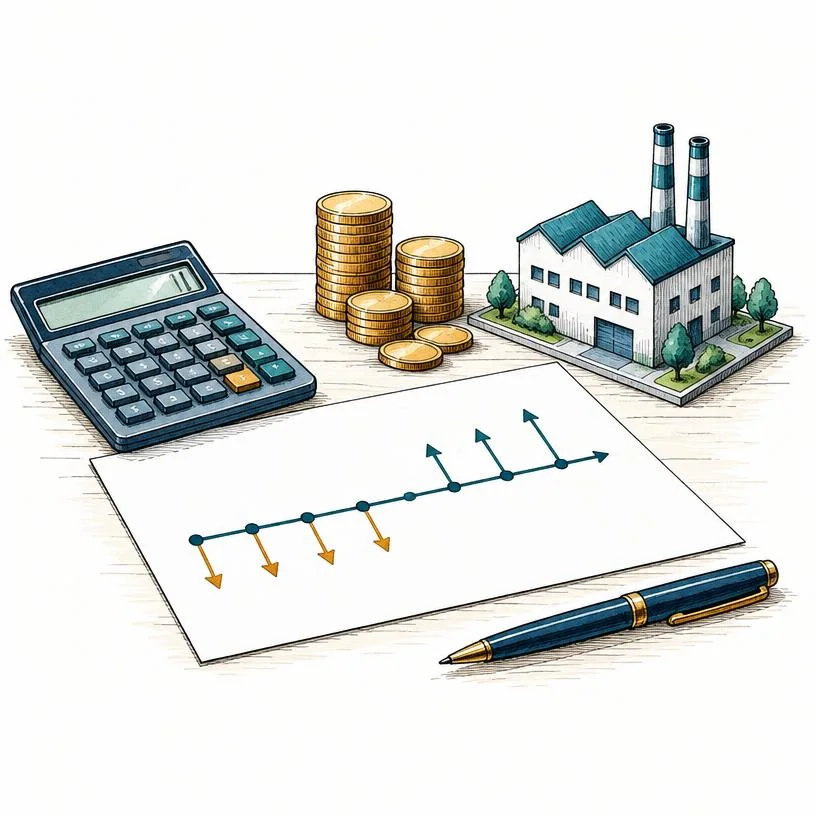 FinancialNPV, IRR and payback: is the investment worth it?Compare discounted value, periodic return and cash recovery using consistent forecasts and tested investment examples.14 November 2026 · 8 min read
 FinancialCompound interest: three real savings scenariosThree practical savings examples show what comes from your deposits, what comes from growth, and which assumptions deserve scrutiny.14 November 2026 · 7 min read
 MathPercentages people get wrong: change, difference and pointsThe denominator determines the answer. Learn to distinguish percentage change, symmetric difference and percentage-point movements.14 November 2026 · 7 min read
Sources and standards
About the author
Dr. Hassan Khames Eliwa holds a PhD in Construction & Built Environment and has more than 20 years of international project controls experience. He is Director of Eliwa Project Controls Limited in Auckland and founder of PMMilestone.org and PMMilestone.com.
Buy me a coffee