Future Value Calculator
This calculator projects the future value of a single starting amount using a fixed compound rate per period. Enter the initial principal, rate and number of periods to estimate the ending balance without additional deposits or withdrawals.
By Dr. Hassan Khames EliwaLast updated
Result
- Starting amount
- $10,000.00
- Periodic rate
- 5.00%
- Periods
- 10
How it works
Compound one opening balance
Future value carries today's principal forward through repeated growth periods. At each period end, the next period starts with the prior balance including its growth. That reinvestment is why compound growth differs from simply multiplying the original principal by the rate and time.
The rate must apply to the same time interval as one period. If you use an annual effective rate, enter years. If you use a monthly rate, enter months. This version accepts nonnegative whole period counts; a count of zero returns the starting amount because no growth interval has elapsed.
Translate quoted rates carefully
A nominal annual rate compounded monthly is commonly divided by twelve to obtain its monthly contractual rate. An effective annual rate has already incorporated compounding, so its equivalent monthly rate comes from taking the twelfth root of one plus that annual rate and subtracting one. These conventions can produce different projections from apparently similar headline percentages.
The calculator intentionally asks for a periodic rate rather than guessing which annual convention applies. Check the product documentation or scenario assumptions. A 1% monthly entry is not interchangeable with a 1% yearly entry, even when both screens show the same rate number.
Understand what stays outside the projection
There are no regular contributions, management fees, taxes or withdrawals. If you want to include recurring deposits, use the savings calculator, which handles a different cash-flow pattern. A changing rate also requires a different model: calculate successive segments with their own rates rather than treating an arithmetic average as an exact substitute.
Negative rates above negative one hundred percent model a declining balance. The output can then be smaller than the starting principal. This is not a simulation of volatile market returns, which may vary sharply from one period to the next. The result is conditional on a constant rate and uninterrupted compounding. Extreme inputs that overflow or collapse the numerical growth factor are rejected.
Worked example
Grow a ten-thousand-dollar balance
Start with $10,000.00, use a 5% annual periodic rate, and enter ten periods. The compound factor is 1.05 raised to the tenth power, producing a future value of $16,288.95. The displayed rate is 5.00% and the period count is 10. There are no later deposits in this example.
For a shorter comparison, keep the $10,000 starting amount but use a 10% rate and two annual periods. The balance becomes $12,100.00. After the first period it is $11,000; the second period earns growth on that larger balance. Simply adding two lots of $1,000 would miss $100 of compounding.
Expert tips
Common mistakes
- Using simple-interest arithmetic for compound growth. Multiplying principal by rate and periods does not reinvest earlier gains. The difference becomes more noticeable as time or the rate increases.
- Adding contributions to the starting principal. A deposit made years later does not receive the same growth time as money invested today. Use a cash-flow model that respects each contribution date.
- Reading a constant return as a forecast guarantee. Market returns, account terms and personal circumstances can change. A tidy projection is a scenario, not evidence that the ending balance will occur.
For education, not financial advice. Results are estimates based on the inputs you give. Lenders, tax authorities and advisers may use different rules, fees and rounding. Check the numbers with a qualified professional before you commit to anything.
Frequently asked questions
Can this model a loss?
Yes. Enter a negative periodic rate greater than negative one hundred percent. The balance declines by that fixed percentage each period, with later losses applying to the reduced balance.
What happens at zero percent?
The ending balance equals the starting amount regardless of the accepted number of periods. Without growth or new cash flows, there is nothing to change the principal.
Can I use months instead of years?
Yes. Use a monthly rate and count months. The formula is not tied to a calendar unit, but the rate and the period count must describe matching intervals.
Are dividends or interest reinvested?
The compound formula assumes all modeled growth stays in the balance. If payments are taken out rather than reinvested, the projected future value will not describe that cash-flow pattern.
Why can a very large input produce an error?
Computers have finite numeric limits. The calculator rejects growth factors or ending balances outside its usable range instead of displaying infinity or silently treating an underflowed positive balance as zero.
Related calculators
Related guides
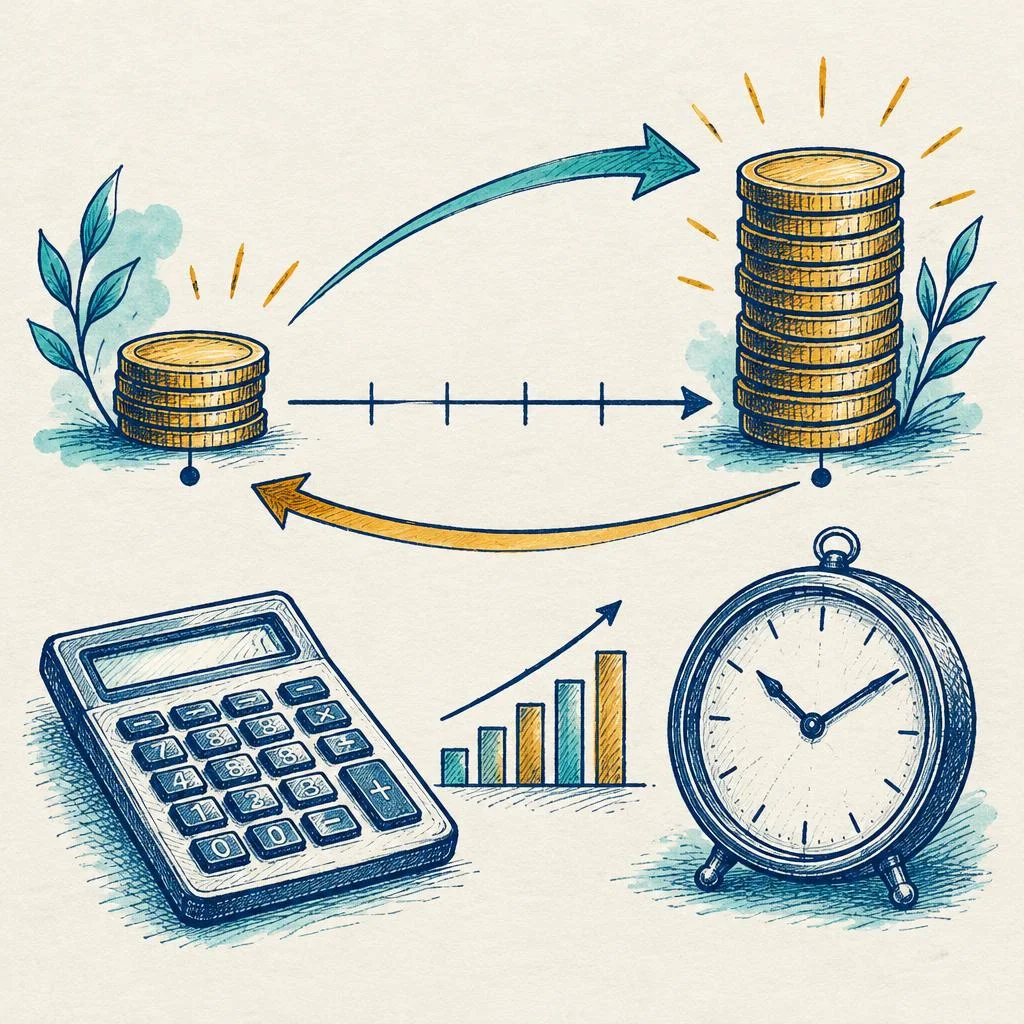 FinancialPresent and future value: move money through timeUnderstand discounting and compounding, compare dated cash flows, and keep nominal rates, inflation and payment timing consistent.14 November 2026 · 8 min read
 FinancialMargin vs markup: the pricing mistake that eats profitA percentage added to cost is not the same percentage retained from sales. That denominator mistake can quietly undermine a pricing plan.14 November 2026 · 7 min read
 FinancialCompound interest: three real savings scenariosThree practical savings examples show what comes from your deposits, what comes from growth, and which assumptions deserve scrutiny.14 November 2026 · 7 min read
About the author
Dr. Hassan Khames Eliwa holds a PhD in Construction & Built Environment and has more than 20 years of international project controls experience. He is Director of Eliwa Project Controls Limited in Auckland and founder of PMMilestone.org and PMMilestone.com.
Buy me a coffee