Comparing two loan offers: when the lower rate loses
Compare loan payments, upfront fees, full-term costs and early payoff balances so a lower interest rate does not disguise a worse offer.
By Dr. Hassan Khames EliwaLast updated
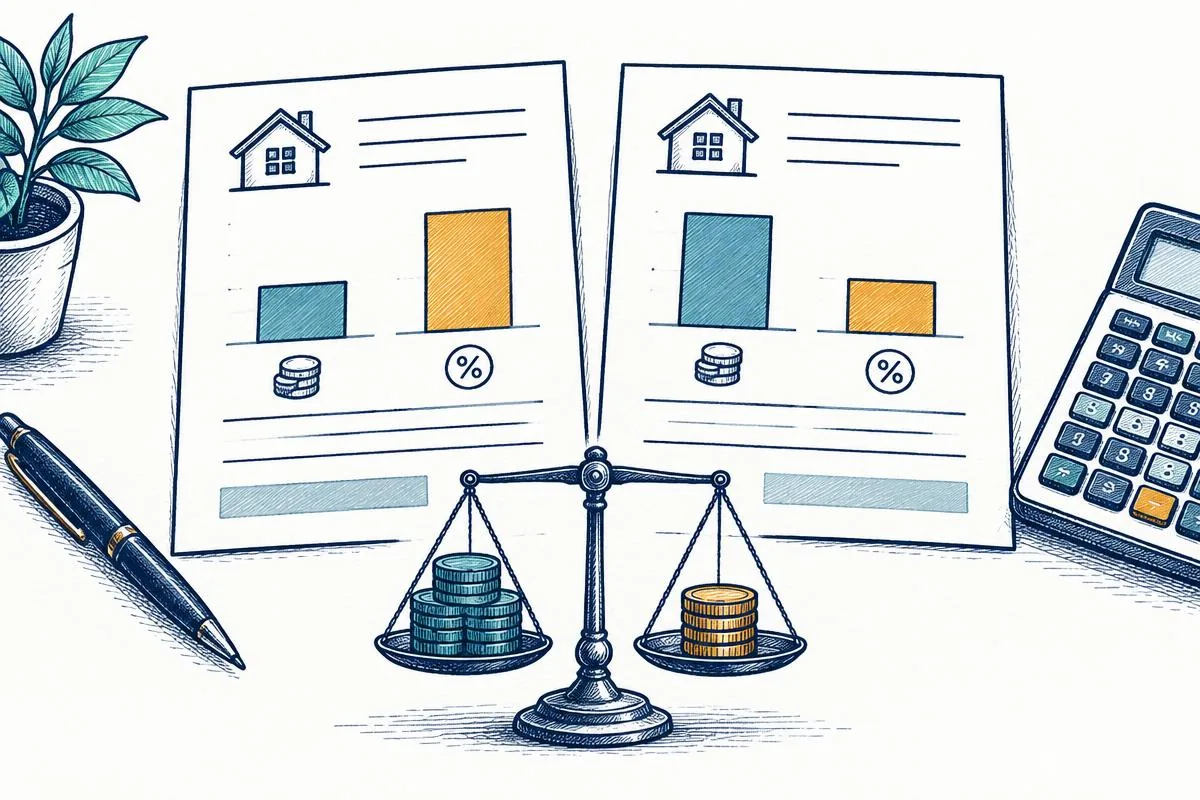
Compare the money you receive with the money you repay
A lender offering the lowest interest rate has not necessarily offered the cheapest borrowing. Fees can outweigh the interest saving, particularly on a modest balance or a loan repaid early. The practical comparison begins with equal usable proceeds, then follows every payment over the period you expect to keep the debt.
Use the loan comparison calculator to put offers side by side. First write down whether each fee is paid separately, added to principal or deducted from the advance. Those arrangements create different cash flows even when the advertised loan amount is identical.
The worked offers below are hypothetical fixed-rate instalment loans. They are not market quotes, lending recommendations or representations of any lender's current terms. Currency units are interchangeable as long as the same currency is used throughout.
Normalize the offers before calculating
Both examples provide a principal advance of 20,000, repaid through thirty-six equal end-of-month payments. Offer A has an annual nominal interest rate of 8% and a 900 upfront fee. Offer B has a 9.5% annual nominal rate and a 100 upfront fee.
Assume fees are paid separately at the start, interest is calculated using the annual rate divided by twelve, and there are no other charges, optional products or penalties. Neither loan has a balloon. Keep full precision internally; displayed amounts are rounded to two decimals.
| Comparison item | Offer A | Offer B |
|---|---|---|
| Principal advanced | 20,000.00 | 20,000.00 |
| Nominal annual rate | 8.00% | 9.50% |
| Term | 36 months | 36 months |
| Fee paid upfront | 900.00 | 100.00 |
| Monthly principal and interest | 626.73 | 640.66 |
| Interest over full term | 2,562.18 | 3,063.72 |
| Payments plus upfront fee | 23,462.18 | 23,163.72 |
Offer A saves 501.54 in interest but charges 800 more upfront. Offer B therefore costs 298.46 less over the full term on these assumptions. The lower rate loses because its interest advantage is smaller than its fee disadvantage.
Understand the payment calculation
For principal P, monthly rate r and number of monthly payments n, the level payment is P × r / (1 − (1 + r) raised to the power −n). Offer A uses r = 0.08 / 12 and n = 36, producing an unrounded payment of approximately 626.727309.
The loan calculator helps check the amortizing payment separately. Full-term interest is total scheduled payments minus the original principal. Full-term borrowing cost here is that interest plus the fee, not the entire repayment total, because repayment includes the money originally borrowed.
Actual lenders may round each payment and adjust the final instalment. Daily interest, irregular first periods and different payment dates can also create small differences. Use the lender's contractual schedule for the final decision, not a claim that an illustrative formula must match every statement to the cent.
Do not confuse rate conversion with fee inclusion
A nominal annual rate and an effective annual interest rate are different presentations of compounding. The effective annual rate calculator can normalize compounding conventions. Converting the interest rate alone does not automatically include origination fees or other borrowing costs.
APR is designed to express borrowing cost using prescribed rules, but the precise included charges and calculation requirements depend on the product and jurisdiction. For US mortgages, the Consumer Financial Protection Bureau recommends comparing loan amounts, interest rates, payments, upfront loan costs and lender credits rather than relying on a headline rate. 1
That mortgage guidance supports a disciplined comparison process. It does not turn these hypothetical instalment loans into mortgages or establish identical disclosure rules for every country and credit product. Ask which charges the quoted APR includes and obtain the underlying fee schedule.
Test an early payoff using the outstanding balance
A borrower expecting to repay after twelve monthly payments should not compare thirty-six-month totals. Nor should they simply add the first twelve payments and the initial fee. A lower payment may leave a different amount of principal outstanding.
Immediately after payment twelve, the calculated balance is 13,857.28 for A and 13,953.31 for B. Assuming no prepayment penalty or additional settlement charge, financing cost to that point equals twelve payments plus the outstanding balance plus the fee minus the original advance.
For A, that is approximately 2,278.01. For B, it is 1,741.21. Offer B is cheaper by 536.79 at the twelve-month exit, calculated before rounding. Use the actual settlement quote when deciding: it may include accrued interest to the payoff date and contractual charges not represented here.
Treat break-even shortcuts cautiously
The monthly payment saving with A is approximately 13.93. Dividing the extra 800 fee by that saving gives about 57.42 months, longer than the thirty-six-month term. This simple calculation confirms that payment savings alone cannot recover the extra fee during this loan.
However, it is not a complete early-payoff break-even calculation because the two outstanding balances differ. To compare an exit month, calculate payments made, the remaining balance and all applicable fees at that month. Where the time value of money matters, discount the cash flows consistently as well.
A longer holding period does not automatically make the lower rate preferable. Its maximum saving over the actual contractual term may never offset the fee. Calculate the whole term before assuming a break-even point exists.
Keep usable proceeds equal when fees are financed
If A adds the 900 fee to the balance, it is no longer a 20,000-principal loan under the original example. The borrower may receive 20,000 but repay principal of 20,900, with interest charged on the financed fee. Recalculate the payment and balance from that higher principal.
If the lender instead deducts 900 from a stated 20,000 advance, the borrower receives only 19,100. Comparing that loan directly with another that delivers 20,000 is not like-for-like. Determine how much must be borrowed to deliver the same required cash, then compare the resulting obligations.
Separate affordability from total cost
Offer A has the lower monthly payment despite the higher full-term cost. That can matter to a constrained household, but the 900 fee also reduces available cash at the start. An offer is not affordable merely because its instalment is smaller.
Check the complete monthly obligation, including compulsory insurance or service charges where applicable. Keep taxes and other ownership costs separate if they are not loan costs, but include them in the household budget. A cheaper loan can still be an unsuitable commitment if income is uncertain or the required initial cash exhausts reserves.
For mortgages, the CFPB Loan Estimate explainer distinguishes principal and interest, estimated total payment, cash to close, prepayment penalties and balloon payments. These are separate questions that deserve separate checks. 2
Finish with a decision record, not just a winner
Record the quote date, rate-lock status, term, payment schedule, net proceeds, mandatory fees, optional products and early-settlement provisions. A fixed-rate offer and a variable-rate offer require additional scenarios because their future payments are not equally certain.
Then compare at least the full contractual term and a plausible early exit. State what could reverse the ranking: a different holding period, financed fees, a penalty or a rate change. The best comparison explains why one offer fits the expected cash flows, rather than declaring that either the lowest rate or the lowest fee always wins.
Calculators used in this guide
Frequently asked questions
Is the lowest interest rate always the cheapest loan?
No. Upfront fees, recurring charges and the repayment horizon can outweigh its interest saving. Compare equal usable proceeds and all relevant cash flows.
Should I compare APR or the interest rate?
Use applicable APR disclosures as one comparison tool, but also inspect fees, payments, net proceeds and early-payoff terms. APR rules vary by product and jurisdiction.
How do I compare loans repaid early?
At the intended exit date, add payments already made, the settlement balance and relevant charges, then subtract the original advance to calculate financing cost.
What if a fee is added to the loan?
Include it in financed principal and recalculate interest and payments. Do not treat a financed fee as though it were paid separately at the start.
Why might my lender payment differ slightly?
Lender rounding, daily interest, irregular payment periods and contractual conventions can differ from a simplified monthly amortization model.
Sources and standards
About the author
Dr. Hassan Khames Eliwa holds a PhD in Construction & Built Environment and has more than 20 years of international project controls experience. He is Director of Eliwa Project Controls Limited in Auckland and founder of PMMilestone.org and PMMilestone.com.
Buy me a coffee