Loan Comparison Calculator
Compare two fixed-rate installment loans using principal, annual contract interest rate, monthly term, and an upfront cash fee. The comparison shows payment, interest, total cash cost, and a narrowly defined fee-recovery month when the offers are comparable.
By Dr. Hassan Khames EliwaLast updated
Result
- Fee versus rate break-even
- Month 27 (higher-fee offer B)
Fixed-rate offers; cash fees paid at signing
| Measure | Offer A | Offer B |
|---|---|---|
| Monthly payment | $405.53 | $386.66 |
| Total interest | $4,331.67 | $3,199.36 |
| Upfront fee | $0.00 | $500.00 |
| Total cost including principal | $24,331.67 | $23,699.36 |
How it works
Monthly amortization
For each offer, monthly rate r equals the annual contract rate divided by 1,200. Payment M = P × r ÷ (1 − (1 + r)^−n), where P is principal and n is the number of months. With zero interest, payment equals P ÷ n. Total interest equals M × n − P. Total cost including principal equals M × n plus the upfront fee.
Fees are paid separately at signing, not added to principal. The entered rate should therefore be the contract interest rate, not a disclosed APR that already incorporates fees. Combining an inclusive APR with a separate fee can count borrowing costs twice. Payments are calculated without intermediate cent rounding, so an actual lender’s final payment may differ slightly.
Fee versus rate recovery
For matching principal and term, identify the offer with the higher cash fee. Extra fee equals its fee minus the other offer’s fee. Monthly saving equals the lower-fee offer’s payment minus the higher-fee offer’s payment. Break-even is the first whole month when cumulative payment savings cover the extra fee.
If the higher-fee loan has no payment saving, recovery never occurs. If the calculated month exceeds the common term, recovery is not reached during the loan. Equal fees require no recovery period. Different principals or terms make this payment-savings comparison inappropriate, so the calculator explicitly marks break-even not applicable.
Worked example
Scenario 1: a fee buys a lower rate
Offer A borrows $20,000 at 8% for 60 months with no fee. Offer B borrows $20,000 at 6% for 60 months with a $500 cash fee. Payments are $405.53 and $386.66. Total interest is $4,331.67 and $3,199.36. Total cost including principal is $24,331.67 and $23,699.36. The extra fee is recovered in month 27 using unrounded payment savings.
Scenario 2: zero-interest offers
Both offers borrow $12,000 at 0% over 12 months. Offer A charges no upfront fee; offer B charges $100. Both payments are $1,000.00 and both interest totals are $0.00. Total costs are $12,000.00 and $12,100.00. The higher-fee offer has no monthly saving, so its extra fee is never recovered.
Expert tips
Common mistakes
- Do not call payment-savings break-even a complete early-exit comparison. Outstanding balances, prepayment penalties, and settlement charges are not included in the cumulative payment method used here.
- Do not choose solely by monthly payment. A longer term may reduce the installment while increasing total interest, and unequal principal amounts can make a payment comparison misleading.
- Do not use these fixed-rate results for adjustable rates, interest-only periods, balloon structures, or daily-interest contracts without separately modeling the timing and terms those products require.
For education, not financial advice. Results are estimates based on the inputs you give. Lenders, tax authorities and advisers may use different rules, fees and rounding. Check the numbers with a qualified professional before you commit to anything.
Frequently asked questions
Is total cost just interest?
No. The table’s total cost includes repayment of principal, all modeled interest, and the upfront cash fee. To isolate borrowing charges, compare total interest plus the fee instead of the full repayment total.
What if terms differ?
Payments and full-term costs are still displayed, but fee versus rate break-even is marked not applicable. Different repayment schedules require a balance-aware comparison at a common holding date, not simple cumulative payment savings.
Are fees financed?
No. They are assumed paid in cash at signing. If a lender adds a fee to the balance, include it in the amount borrowed and avoid entering the same fee again as cash.
Does break-even include investment returns?
No. It is an undiscounted cash-flow recovery calculation. It ignores opportunity cost, inflation, taxes, and what the upfront fee could earn elsewhere, so it is not a net-present-value decision rule.
Can I compare zero-rate loans?
Yes. Their payment is principal divided by months, with zero modeled interest. Any difference in cash fees remains visible in total cost even when monthly payments are identical.
Related calculators
Related guides
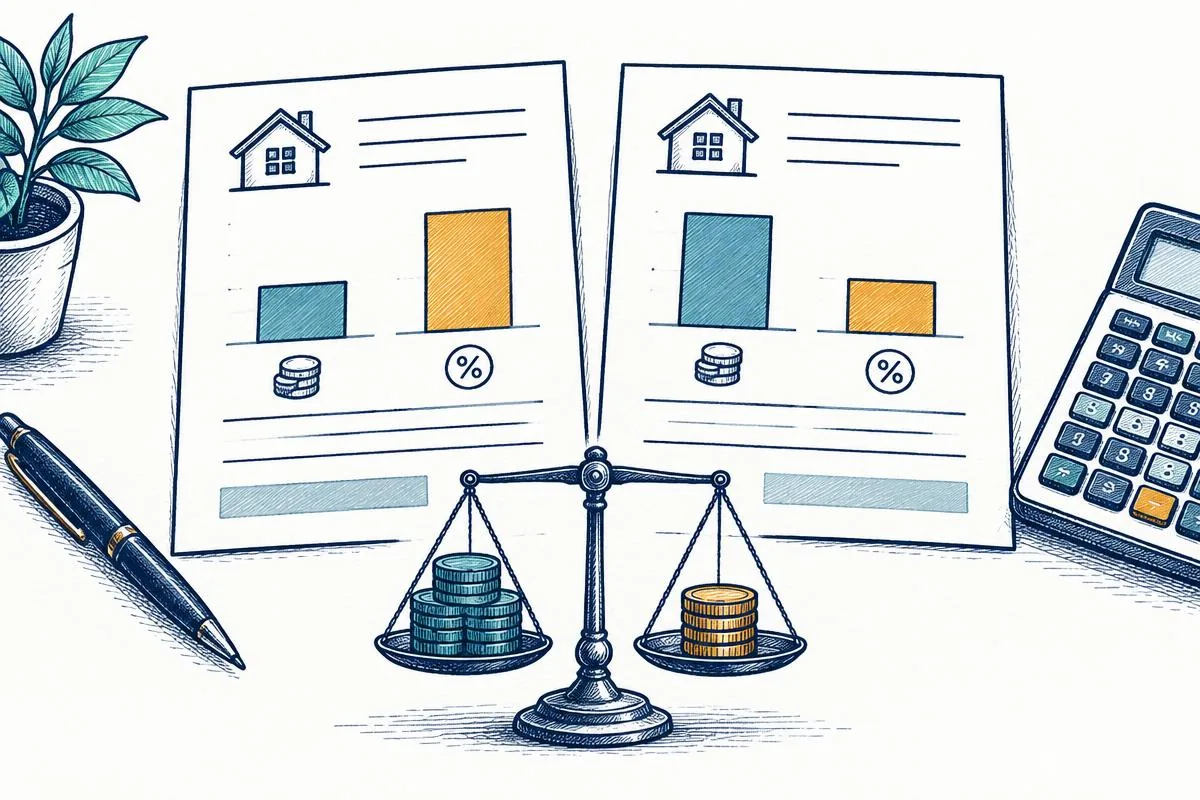 FinancialComparing two loan offers: when the lower rate losesCompare loan payments, upfront fees, full-term costs and early payoff balances so a lower interest rate does not disguise a worse offer.16 November 2026 · 8 min read
 FinancialThe 50/30/20 budget and how big an emergency fund should beUse percentages to start the conversation, then size your cash reserve around the bills that would survive an income shock.15 November 2026 · 8 min read
Sources and standards
About the author
Dr. Hassan Khames Eliwa holds a PhD in Construction & Built Environment and has more than 20 years of international project controls experience. He is Director of Eliwa Project Controls Limited in Auckland and founder of PMMilestone.org and PMMilestone.com.
Buy me a coffee