
How to Calculate Construction Cost Escalation in 2026: Midpoint, Cash Flow and Rate Selection
A practical method for escalating a base-date estimate: midpoint of construction, cash-flow phasing, rate sources, sensitivity, and common mistakes.
By Dr. Hassan Khames EliwaLast updated
Why escalation deserves its own line in 2026
Most estimates are priced in today's money and spent in tomorrow's. Escalation is the bridge between the two: the allowance that moves a base-date estimate to the prices you will actually pay when the work happens. When input prices were drifting up a couple of percent a year, a rough uplift buried in contingency rarely hurt anyone. That is no longer a safe habit.
The Associated General Contractors of America reported that the producer price index for inputs to new nonresidential construction rose 13.3% between October 2025 and October 2026, with diesel more than doubling over the same twelve months. Input prices are not the same thing as the price an owner pays for a finished building, but they show how quickly the ground can move under a tender. An estimate dated in late 2026 for a project that will not reach site until the second half of 2027 carries real exposure, and the board approving that budget deserves to see it as a separate, explained number.
This guide walks through the method I would want to see in any estimate I was asked to review: pick the right rate, escalate to the right date, phase it against a realistic cash flow, and keep it apart from contingency. The arithmetic is simple. The judgment around it is where budgets are won or lost.
What escalation is, and what it is not
Escalation is the expected change in the price of the same scope between the estimate's base date and the time the money is spent. Nothing about the building changes. Only the price level does.
That definition rules out several things people routinely bundle into it:
- Scope growth. Adding a level of basement parking is a scope change, not escalation, even if it happens during a period of inflation.
- Design development risk. Allowances for an immature design belong in design contingency or estimating allowances.
- Market-specific shocks you can name. A known long-lead switchgear premium is better priced inside that package, where it can be tracked and challenged.
- Risk contingency. The Australian infrastructure department's escalation guidance puts it plainly: escalation should not be included within project contingency. The two use different methods and answer different questions.
The core formula
For a single, constant annual rate, escalation compounds over the time between the base date and the point the cost is incurred:
When you have a published price index instead of a forecast rate, the factor is just a ratio:
The University of Michigan's architecture and engineering design guidelines use exactly the compounded form, with time measured in days divided by 365.25. Their own illustration, 460 days at 3% per year, gives 3.79% escalation, which you can reproduce with the cost escalation calculator by entering a 3% rate and 1.2594 years.
The question that matters more than the formula is which date sits at the end of that exponent.
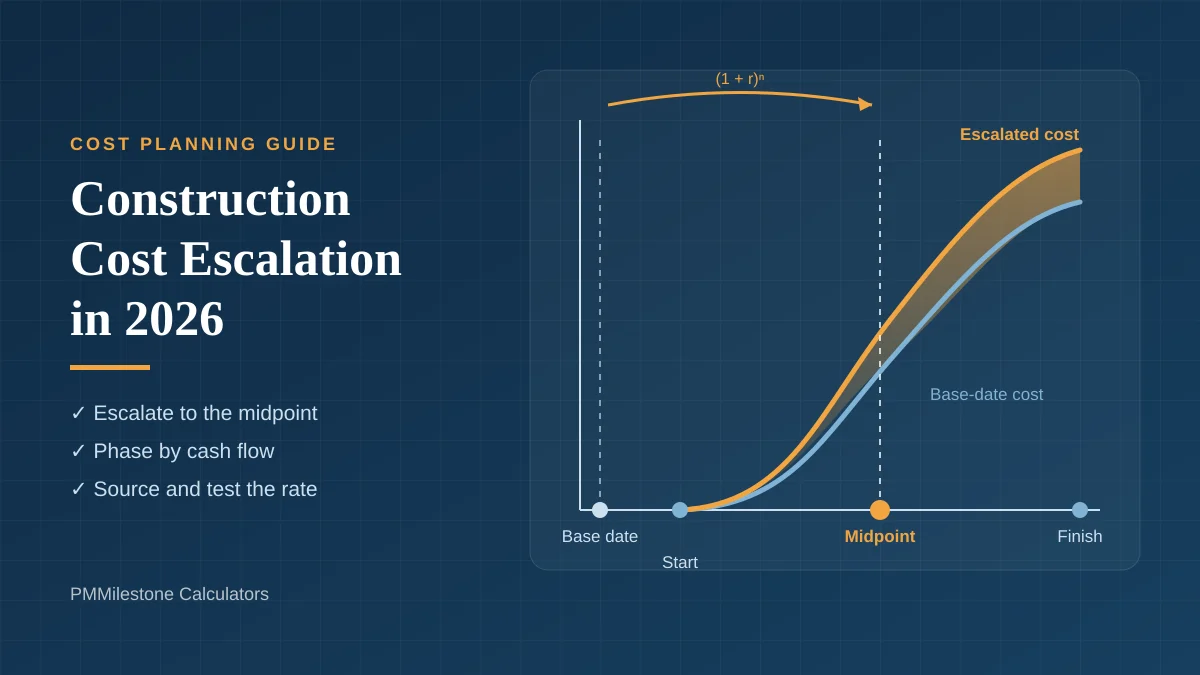
Escalate to the midpoint of construction, not the start
The most common shortcut I see in early estimates is escalating to the construction start date. It feels conservative because it is a date everyone knows. It is actually the least conservative choice, because almost none of the money is spent on day one.
The construction economist Ed Zarenski describes the convention used across the industry: escalate from the current cost to the midpoint of construction, because roughly half the project cost occurs before that point and half after. For a traditional S-shaped spend profile, the midpoint is a fair single-date proxy for the whole cash flow.
A worked example
Take a mid-size education building with these assumptions:
| Item | Assumption |
|---|---|
| Base estimate (construction trades, excl. contingency) | $2,400,000 |
| Estimate base date | 1 December 2026 |
| Construction start | 1 September 2027 |
| Construction duration | 18 months (finish 1 March 2029) |
| Midpoint of construction | 1 June 2028 |
| Assumed escalation rate | 5.0% per year, compounded |
Here is what each choice of end date does to the allowance:
| Escalate to | Years from base date | Factor | Allowance | Verdict |
|---|---|---|---|---|
| Construction start | 0.75 | 1.03727 | $89,449 | ⚠️ Understated |
| Midpoint of construction | 1.50 | 1.07593 | $182,232 | ✅ Standard practice |
| Completion | 2.25 | 1.11603 | $278,472 | ⚠️ Overstated |
Escalating to start leaves about $93,000 out of the budget compared with the midpoint method. On a project of this size, that is roughly the value of a full mechanical variation, and it tends to surface at exactly the wrong moment: when tenders come in and the design team is asked to "find savings" in a design that is already finished.
You can check the midpoint figure yourself with a base cost of 2,400,000, a 5% rate and 1.5 years in our cost escalation calculator. If you need the exact number of days between your base date and the midpoint, the date difference calculator saves counting months on your fingers.
When the midpoint is not good enough: phase it
The midpoint shortcut assumes a reasonably balanced spend curve. Real projects are not always so polite. A fit-out with heavy equipment procurement near the end, or a civil job with a big earthworks spend up front, can push the "centre of gravity" of the money well away from the calendar midpoint.
The more robust approach is to escalate each slice of the cash flow to its own spending date and add the results. Australia's infrastructure guidance does this financial year by financial year; on smaller jobs I find six-month blocks are detailed enough.
Using the same project, split into three six-month blocks:
| Spend block | Share of base | Base amount | Years to block midpoint | Escalation |
|---|---|---|---|---|
| Sep 2027 – Feb 2028 | 20% | $480,000 | 1.0 | $24,000 |
| Mar 2028 – Aug 2028 | 55% | $1,320,000 | 1.5 | $100,227 |
| Sep 2028 – Feb 2029 | 25% | $600,000 | 2.0 | $61,500 |
| Total | 100% | $2,400,000 | $185,727 |
With a fairly normal S-curve, the phased answer ($185,727) is within 2% of the midpoint shortcut ($182,232). That is reassuring, and it is why the midpoint convention has survived so long.
Now change only the shape of the spend:
| Spend profile (block 1 / 2 / 3) | Phased escalation | Difference vs. midpoint shortcut |
|---|---|---|
| Front-loaded (40% / 45% / 15%) | $166,904 | −$15,328 |
| Balanced S-curve (20% / 55% / 25%) | $185,727 | +$3,495 |
| Back-loaded (10% / 40% / 50%) | $207,893 | +$25,661 |
The back-loaded case carries about $26,000 more escalation than the shortcut suggests, on exactly the same base cost and rate. If you have a cost-loaded programme, build the spend profile with the S-curve generator or the project cash flow forecast calculator and escalate the blocks, rather than trusting a single date. Our guide to reading an S-curve explains how to sanity-check the shape before you rely on it.
Choosing the rate: the hard part
The formula does not care where your rate comes from. Your reviewers will. Here is how I rank the usual sources, from most to least defensible for a whole-building budget:
| Source | What it measures | 👍 Good for | 👎 Watch out for |
|---|---|---|---|
| Final-cost (selling price) indices | Price owners pay for completed work | Whole-project budgets | Mostly cover nonresidential buildings |
| Your own tender history | Price you actually achieved | Repeat building types in one region | Small samples, mixed scopes |
| Published forecasts by sector | Expected future final cost movement | Multi-year capital plans | Forecasts get revised; keep the version date |
| Input price indices (PPI inputs, material indices) | Cost of materials and some inputs | Package-level pricing of steel, copper, fuel | Exclude labour productivity and contractor margin |
| General inflation (CPI) | Household consumer prices | Almost never right for construction | Usually understates construction cost movement |
Zarenski makes a point that is worth repeating to every finance team: input indices and final-cost indices are different animals. Material input prices can spike while bid prices barely move because contractors absorb part of the increase, or the reverse can happen in a hot market when margins expand. Use input indices to understand pressure on specific packages, and final-cost indices or real tender data to escalate the whole estimate.
For context, his long-run figures for nonresidential buildings average about 3.9% a year since 2011 excluding the 2021–2022 surge, and about 4.7% including it. Those are history, not a forecast, but they give you a sense of what "normal" has looked like and how far an extraordinary year can pull the average.
Testing the rate with a sensitivity table
Because the rate is the most uncertain input, show the decision-makers what a range of rates does to the allowance. On our $2.4M example, escalated 1.5 years to the midpoint:
Each percentage point moves the allowance by roughly $36,000 to $37,000 on this project. That single sentence is often more useful in a steering committee than a page of index commentary, because it turns a debate about economics into a decision about how much risk the owner wants to hold.
If the uncertainty in the rate is genuinely large, it is reasonable to carry a central escalation figure in the escalation line and treat the spread above it as a quantified risk. Our article on expected monetary value and contingency shows one way to size that kind of allowance without double counting it.
Using different rates for different years
Forecasts rarely assume the same rate every year. If you expect 5% in the first year and 4% after that, multiply the factors rather than averaging the rates:
On the $2.4M base escalated to the midpoint, that gives $163,765 rather than $182,232 at a flat 5%. In the cost escalation calculator, run each period separately and carry the escalated result forward as the base for the next period; the compounding then works exactly as it does on paper.
Real-world patterns worth recognising
A few situations come up again and again on projects, and each needs slightly different handling:
- The delayed approval. A business case is approved on an estimate dated eighteen months earlier, but the escalation was calculated to the original start date. The fix is not a new contingency; it is to re-base. Calculate escalation from the original base date to the new midpoint and add the difference to the budget. Zarenski's guidance makes the same point: any delay requires calculating inflation and adding it to the prior budget.
- The lump-sum tender with a fixed price. Once a fixed-price contract is signed, the contractor carries escalation on the contracted scope. The owner's remaining exposure shifts to provisional sums, unlet packages, variations, and any rise-and-fall clause. Escalation does not disappear; it moves to the parts of the budget that are still open.
- The multi-stage programme. On a campus or network programme spanning several years, each stage needs its own midpoint. One blended rate applied to a single date for the whole programme almost always understates the later stages.
- The commodity-heavy package. When steel, copper or fuel make up a large share of a package, it can be sensible to escalate that package separately with a relevant input index while the rest of the estimate uses a whole-building rate. Document the split so nobody escalates the same steel twice.
Common mistakes
| ❌ Mistake | Why it hurts | ✅ Better practice |
|---|---|---|
| Escalating to construction start | Ignores that most of the money is spent later | Escalate to the midpoint, or phase by cash flow |
| Adding the rates instead of compounding | Understates multi-year escalation | Multiply annual factors |
| Burying escalation in contingency | Hides a predictable cost inside a risk allowance | Show escalation as its own line with its own basis |
| Using CPI for a building | Consumer prices do not track construction prices | Use construction final-cost indices or tender data |
| Escalating an estimate that already includes escalation | Double counts the allowance | Record the price base date of every rate you import |
| Forgetting the base date entirely | Reviewers cannot tell what money the estimate is in | State the base date on the cover page and in the summary |
| Applying escalation to the contingency but not saying so | Creates disputes about the total | Decide and document whether contingency is escalated |
The double-counting mistake deserves special attention. Subcontractor quotes, cost plan rates from a previous project, and unit rates in a pricing book all have their own price dates. If a quote received in August 2027 already allows for prices through to installation, escalating it again from December 2026 inflates the budget. Every imported rate needs a date, and the escalation calculation should start from that date, not from the estimate's cover sheet.
Expert tips from estimate reviews
- Write the base date into the estimate title. "Stage 2 Cost Plan, December 2026 prices" removes an entire category of confusion when the estimate is circulated months later.
- Show the escalation calculation, not just the result. Base cost, base date, spend point or profile, rate, source, version date. Five lines that let anyone rebuild your number.
- Refresh at every gateway. Rates and programmes both change. A cost plan update that re-prices the scope but keeps the old escalation figure is only half updated.
- Separate escalation in cost reports. When escalation is spent or released, report it on its own line so the project team can see whether the market moved more or less than expected.
- Keep your source versions. Forecasts are revised quarterly. If you cite a forecast, save a copy and note its publication date so the assumption can be audited later.
Key takeaways
- ✅ Escalation moves a base-date estimate to the prices of the period when the money is spent. It is not scope, design development, or risk contingency.
- ✅ Compound the rate over time; never add annual rates together.
- ✅ Escalate to the midpoint of construction as a minimum. On our $2.4M example, using the start date instead understated the allowance by about $93,000.
- ✅ Phase escalation against the cash flow when the spend is front- or back-loaded; the shape alone moved our example by up to $26,000.
- ✅ Prefer final-cost indices or real tender data for whole-building budgets, and reserve input indices for commodity-heavy packages.
- ✅ Present a rate sensitivity so decision-makers can choose how much market risk to hold.
Escalation is one of the few parts of an estimate where a clear method beats a clever guess almost every time. Date the estimate, choose and source the rate, escalate to when the money really leaves the account, and keep the result visible. When the market surprises you, and it will, you will know exactly which assumption moved and by how much.
Calculators used in this guide
Frequently asked questions
What is the midpoint of construction in cost escalation?
It is the date halfway between construction start and completion. For a typical S-shaped spend profile, about half of the construction cost is incurred before it and half after, so escalating the base estimate to that single date approximates escalating the whole cash flow.
What escalation rate should I use for a 2026 construction estimate?
Use a sourced, dated rate for your building type and region, ideally from a final-cost (selling price) index, a published sector forecast, or your own recent tender results. Record the source and version date, and show a sensitivity range because the rate is the least certain input.
Is escalation the same as contingency?
No. Escalation covers the expected price change for the same scope between the base date and the spend date. Contingency covers uncertainty in scope, design and risk events. Keeping them on separate lines makes both easier to justify and to track.
Should escalation be compounded or simple?
Compounded. Each year's price increase applies to a price level that has already risen, so the factor is (1 + rate) raised to the number of years. Adding annual rates together understates escalation on multi-year projects.
How do I escalate an estimate when the project is delayed?
Re-base the calculation from the estimate's original base date to the new midpoint of construction, or re-phase the new cash flow, and add the difference to the budget. Do not simply absorb the delay inside the existing contingency.
Can I use the producer price index to escalate a whole building?
Input price indices are useful for commodity-heavy packages such as structural steel or copper cabling, but they exclude labour productivity and contractor margins. For a whole-building budget, a final-cost index or real tender data is usually more representative. You can test either approach with the cost escalation calculator.
Sources and standards
- AGC: Construction input costs rise 13.3% as tariffs, fuel squeeze contractors (Nov 2026)
- Construction Analytics (Ed Zarenski): Construction Cost Inflation 2026
- University of Michigan AEC Design Guidelines DG 2.5: Cost estimating and escalation
- Australian Government Infrastructure Investment Program: Guidance Note 4 - Escalation
- AACE International: Understanding and estimating escalation
About the author
Dr. Hassan Khames Eliwa holds a PhD in Construction & Built Environment and has more than 20 years of international project controls experience. He is Director of Eliwa Project Controls Limited in Auckland and founder of PMMilestone.org and PMMilestone.com.
Buy me a coffee