Critical path and float: a ten-activity example
Work through a ten-activity network, calculate early and late dates, and distinguish total float from free float.
By Dr. Hassan Khames EliwaLast updated
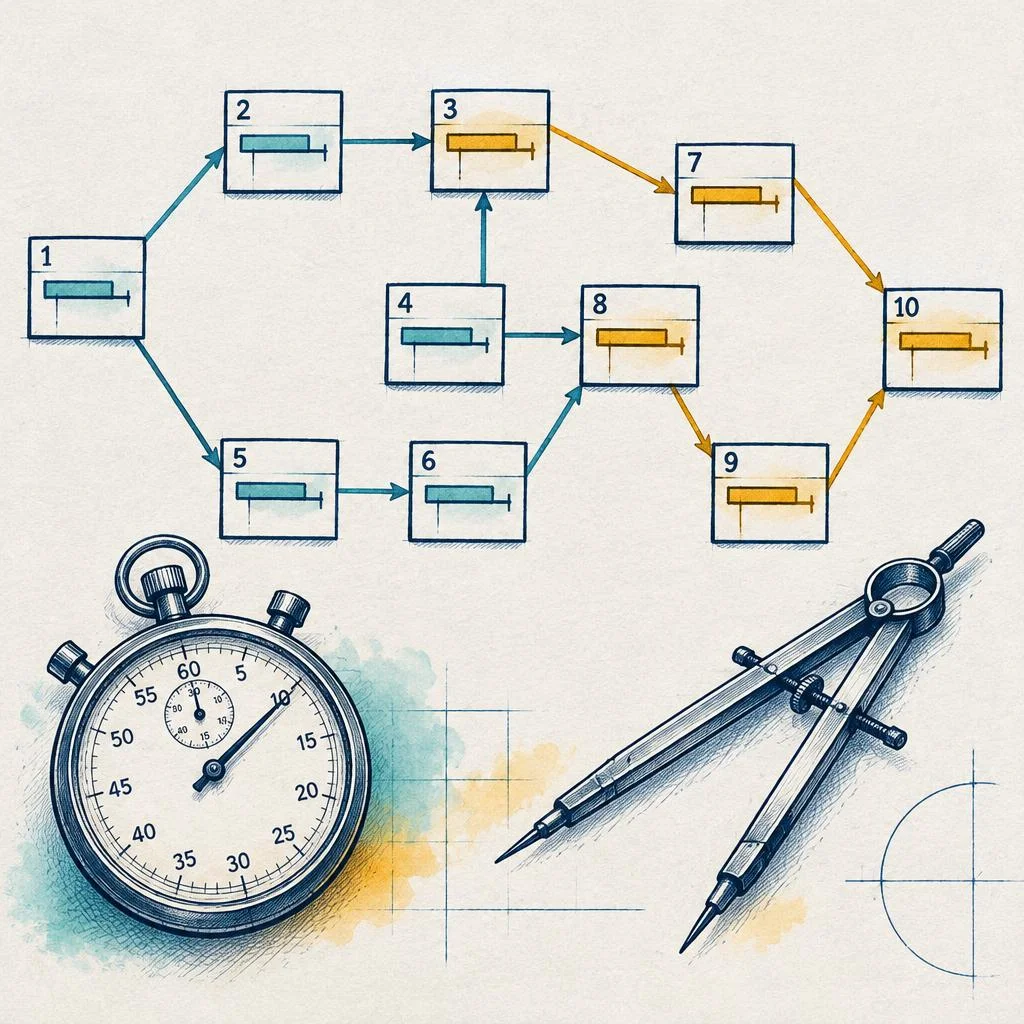
The finish date belongs to a chain, not a task
A critical path is the longest-duration chain of logically connected activities in a schedule network. It determines the earliest modeled completion time. Float measures how far an activity can move before it affects a specified successor or the project finish, depending on which float measure you use.
The practical question is not simply which task is longest. It is which unfinished chain currently controls delivery. A short inspection can control handover while a long fabrication task has room to slip. Use the critical path calculator to reproduce the network below, then inspect the assumptions before accepting its finish as a commitment.
The GAO Schedule Assessment Guide treats valid logic, a credible critical path and reasonable float as connected requirements for a reliable schedule. Its guidance supports the method, not the invented project quantities used in this worked example. 1
Fix the calendar and logic first
Our ten activities represent a small equipment installation. Durations are working days on one shared calendar. All relationships are finish-to-start with zero lag. Resources are available when required, there are no imposed finish constraints, and time starts at boundary zero.
An activity starting at time 2 and lasting three days finishes at time 5. These are elapsed working-time coordinates, not inclusive calendar dates. Mixing the two conventions is an easy way to introduce an apparent one-day disagreement.
| ID | Activity | Duration | Immediate predecessors |
|---|---|---|---|
| A | Confirm requirements | 2 | None |
| B | Detail design | 4 | A |
| C | Prepare procurement package | 3 | A |
| D | Fabricate assembly | 5 | B |
| E | Deliver bought-out items | 4 | C |
| F | Prepare installation area | 3 | B |
| G | Install assembly | 4 | D, E |
| H | Complete utility connections | 2 | F |
| I | Integrated testing | 3 | G, H |
| J | Handover | 1 | I |
Every activity leads to handover. There are no dangling activities whose delays can disappear outside the network. Multiple predecessors mean all listed predecessors must finish before the successor starts.
Make the forward pass
The earliest start, ES, is the maximum earliest finish of an activity's predecessors. Earliest finish, EF, equals ES plus duration. At a merge, taking the minimum predecessor finish would incorrectly allow work to start before all prerequisites are ready.
A starts at 0 and finishes at 2. B therefore runs from 2 to 6, while C runs from 2 to 5. D finishes at 11 and E at 9. G cannot start at 9 merely because the bought-out items have arrived: fabrication is still underway. Its earliest start is max(11, 9) = 11, and its earliest finish is 15.
Meanwhile F runs from 6 to 9 and H from 9 to 11. Testing needs both installation and connections, so I starts at max(15, 11) = 15 and finishes at 18. J finishes at 19. The modeled project duration is therefore 19 working days.
Work backward from that finish
Set the final activity's latest finish, LF, to 19. Latest start, LS, equals LF minus duration. For an activity with several successors, its latest finish is the minimum latest start among those successors.
J must start at 18. I must start at 15. Both G and H must finish by 15, so G's latest start is 11 and H's is 13. Continue upstream using the same rule rather than guessing which branches look important.
| ID | ES | EF | LS | LF | Total float | Free float |
|---|---|---|---|---|---|---|
| A | 0 | 2 | 0 | 2 | 0 | 0 |
| B | 2 | 6 | 2 | 6 | 0 | 0 |
| C | 2 | 5 | 4 | 7 | 2 | 0 |
| D | 6 | 11 | 6 | 11 | 0 | 0 |
| E | 5 | 9 | 7 | 11 | 2 | 2 |
| F | 6 | 9 | 10 | 13 | 4 | 0 |
| G | 11 | 15 | 11 | 15 | 0 | 0 |
| H | 9 | 11 | 13 | 15 | 4 | 4 |
| I | 15 | 18 | 15 | 18 | 0 | 0 |
| J | 18 | 19 | 18 | 19 | 0 | 0 |
Total float is LS − ES, equivalently LF − EF. Free float is the earliest successor start minus the activity's earliest finish; the terminal activity has zero here because its finish is the project finish.
Identify the controlling chain
The zero-total-float chain is A → B → D → G → I → J. Its durations sum to 2 + 4 + 5 + 4 + 3 + 1 = 19.
The procurement chain A → C → E → G → I → J totals 17 days. The connection chain A → B → F → H → I → J totals 15 days. Their differences from 19 explain the two-day and four-day gaps, but those gaps are shared along each branch.
Do not add C's two days of float to E's two days and promise four days of procurement flexibility. If C uses both days, it pushes E's early dates two days later and consumes the branch's available margin.
Total float and free float answer different questions
C has two days of total float but no free float. Delaying C moves E's earliest start immediately, even though the project can still finish at 19. E has two days of free float because installation already waits for D until time 11.
F and H show the same distinction on a larger gap. F can move four days without delaying project completion, but that movement changes H's early start. H can move four days without changing testing's early start.
Float is a calculated consequence of current logic and constraints. It is not automatically a reserve owned exclusively by the activity's contractor or department. Contract terms and governance determine who can consume it.
Test a real change, not an isolated number
Suppose bought-out delivery E takes seven days instead of four. E now finishes at 12, so G starts at 12, I at 16 and J finishes at 20. The three-day delivery increase consumes the two-day branch gap and delays completion by one day.
The critical chain shifts through C and E. Fabrication D now finishes one day before installation can begin. This is why an old critical-path report is not sufficient after a material update.
Conversely, cutting D from five days to four moves completion from 19 to 18. Cutting it to three brings the fabrication and procurement branches level at time 9. Beyond that point, shortening fabrication alone no longer advances installation. The schedule has two competing controlling paths.
Recognize what this network leaves out
Our calculation assumes installation and utility crews do not compete for the same people or equipment. If one crane serves several activities, resource leveling may create a later feasible finish than the pure logic calculation. Adding crew capacity does not automatically repair access conflicts or inspection availability.
Different calendars, relationship types, mandatory constraints and statused work can also complicate float interpretation. Negative float often signals that a required date is earlier than the network can achieve under current assumptions; it does not mean time physically runs backward.
For a live update, retain actual starts and finishes, reassess remaining durations and inspect out-of-sequence work. Never shorten durations merely to restore zero variance. A useful recovery plan identifies a changed production method, additional access, an approved overlap or a removed dependency.
Before circulating the result, check that every activity has the intended predecessor, all durations use the same time basis, merges wait for every prerequisite and the reported finish agrees with the longest chain. Then discuss the next controlling handoff with the person responsible for delivering it.
Calculators used in this guide
Frequently asked questions
Can an activity have total float but no free float?
Yes. Activity C has two days of total float and zero free float. Delaying it shifts E immediately but need not delay project completion.
Can there be more than one critical path?
Yes. Equal longest chains can control completion simultaneously. Shortening only one may not improve the finish date.
Is the longest individual activity always critical?
No. Criticality depends on connected chain duration and the network logic, not the duration of one activity in isolation.
Why does this example start at day zero?
It uses elapsed working-time boundaries. A two-day activity beginning at zero finishes at two; calendar-date labels require a separate working calendar.
Does float guarantee that a delay is safe?
No. Resources, notice obligations, downstream start commitments and uncertainty still matter. Float is only the margin represented in the current schedule model.
Sources and standards
About the author
Dr. Hassan Khames Eliwa holds a PhD in Construction & Built Environment and has more than 20 years of international project controls experience. He is Director of Eliwa Project Controls Limited in Auckland and founder of PMMilestone.org and PMMilestone.com.
Buy me a coffee