Average Calculator
The average calculator summarizes a numeric list using the arithmetic mean, median, mode, range and geometric mean. It sorts values for the median, counts repeated values for the mode, and reports the geometric mean only when every input is positive.
By Dr. Hassan Khames EliwaLast updated
Result
- Median
- 4
- Mode
- 4
- Range
- 4
- Geometric mean
- 3.722419
- Count
- 4
How it works
Choose the summary that answers your question
The arithmetic mean is the total divided by the number of observations. Every value contributes, so one unusually large observation can pull the mean well above what most entries look like. This sensitivity is useful when totals matter, but it can obscure a typical transaction or completion time.
The median is the middle value after sorting. With an even count, it is the average of the two middle values. Sorting is essential: the middle line of an unsorted pasted list has no special statistical meaning.
The mode is the most frequent value. If several values tie for the highest frequency above one, the calculator reports all of them. If every value occurs once, it reports “No mode.” Frequency comparisons use entered numeric values, so 4 and 4.0 count as the same number.
Range is maximum minus minimum. Geometric mean is exp(sum(ln x)/n), equivalent to the nth root of the product for positive inputs. Working with logarithms avoids forming a potentially enormous intermediate product. This calculator requires strictly positive values for that result; it still supplies the other summaries when a list contains zero or negative numbers.
Decide what one entry represents
Before pasting a list, define the observation: a transaction, a person, a task, or a daily total. Mixing individual transactions with daily totals gives larger groups extra influence without making that weighting explicit. Missing observations are not automatically zeros; enter zero only when it represents a real recorded quantity.
The mean, median, range, and geometric mean retain the measurement unit of the inputs. The count does not. A useful report names that unit and the period covered, so a reader can distinguish typical task duration from total workload or the number of tasks completed.
Worked example
Summarizing four task durations
Enter 2, 4, 4, 6 as four durations measured in hours. Their total is 16, and dividing by the count of 4 gives a mean of 4. The middle two sorted values are both 4, so the median is also 4.
The value 4 occurs twice, more often than either 2 or 6, making the mode 4. The range is 6 − 2 = 4. Multiplying the positive values gives 192; its fourth root is the geometric mean, displayed as 3.722419.
The matching mean, median and mode here do not make those concepts interchangeable. If the longest task grows sharply, the mean moves with it, the median may stay unchanged, and the range increases. Use the summaries together before deciding which one belongs in a headline.
Expert tips
Common mistakes
- Averaging group means as though their groups were equally large distorts the overall result. A mean from two observations should not receive the same weight as a mean from two hundred observations.
- Confusing an exact-value mode with a histogram peak changes the question. This calculator counts exact numeric repeats; nearby values such as 3.99 and 4.01 are different observations.
- Currency symbols and thousands separators can make pasted data invalid or split a value into separate observations. Enter plain numbers in one consistent unit, using commas only to separate observations.
Frequently asked questions
Which average is best?
That depends on the purpose. The mean preserves the relationship with the total; the median describes the middle observation; the mode identifies the most frequent exact value. There is no single best summary for every list.
Can a list have several modes?
Yes. If 2 and 5 each occur three times and every other value occurs less often, both are reported. When every value appears once, this calculator follows the convention of reporting no mode.
Why is geometric mean unavailable for zero?
The logarithmic geometric-mean calculation requires strictly positive inputs. A zero or negative value therefore disables that result while leaving mean, median, mode, range and count available.
Can I calculate a weighted average?
There is no separate weight field. If each observation represents one equally weighted item, enter it once. For grouped data with different weights, calculate the sum of value times weight divided by the total weight separately.
How many numbers can I enter?
The input accepts up to 10,000 finite values separated by spaces, commas, semicolons or line breaks. For variability beyond the range, use the standard deviation calculator.
Related calculators
Related guides
 MathWeighted averages: where simple averages misleadChoose weights that match the question, combine rates from their denominators, and avoid misleading averages of prices, speeds and percentages.16 November 2026 · 8 min read
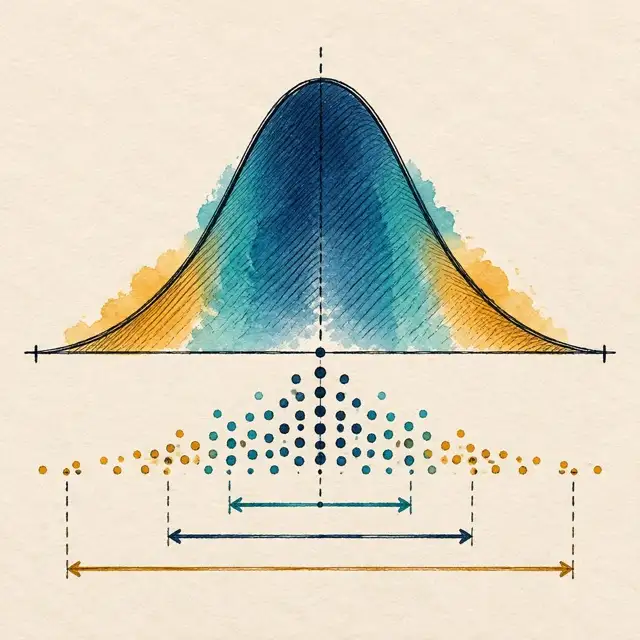 MathStandard deviation without the jargonThe average tells you the centre. Standard deviation helps describe the spread, provided you know what the data represents.14 November 2026 · 7 min read
 MathPercentages people get wrong: change, difference and pointsThe denominator determines the answer. Learn to distinguish percentage change, symmetric difference and percentage-point movements.14 November 2026 · 7 min read
Sources and standards
About the author
Dr. Hassan Khames Eliwa holds a PhD in Construction & Built Environment and has more than 20 years of international project controls experience. He is Director of Eliwa Project Controls Limited in Auckland and founder of PMMilestone.org and PMMilestone.com.
Buy me a coffee