Crew Size & Man-Hours Calculator
Translate work quantity and productive output into labor hours, then size a whole-person crew for an available working window. This calculator separates productive man-hours from scheduled attendance and shows the work capacity created by rounding the crew upward.
By Dr. Hassan Khames EliwaLast updated
Result
- Productive man-hours
- 500.00
- Required scheduled man-hours
- 625.00
- Crew scheduled hours available
- 640.00
- Crew work capacity
- 1,024.00
- Spare work capacity
- 24.00
How it works
Define a rate with a clear denominator
Output means completed work units per productive worker-hour. Quantity and output must share the same work unit, such as blocks, square metres or installed metres. Productive man-hours equal quantity divided by output. A crew-hour is not a worker-hour: a six-person crew working one hour consumes six worker-hours. If your historical rate is measured per crew-hour, convert it using the observed crew composition before entering it here.
Apply utilization once
Utilization is the fraction of scheduled time expected to produce output at the entered productive rate. Required scheduled man-hours equal productive man-hours divided by utilization expressed as a decimal. For example, 80% utilization turns 500 productive hours into 625 scheduled hours. If an observed output rate already uses all paid attendance hours, entering a reduced utilization again would count those losses twice. State the rate convention on the estimate sheet.
Calculate the minimum whole crew
One worker supplies available working days × scheduled hours per day. Divide required scheduled man-hours by that individual availability, then round upward to obtain the minimum crew. Even a small positive remainder calls for another worker if everyone must cover the full window. Days can be fractional when the usable work window is shorter than a shift. Hours per day must be positive and cannot exceed 24; utilization must be greater than zero and at most 100%.
Check the capacity created by rounding
Crew scheduled hours available equal whole crew × days × hours per day. Work capacity equals those hours × utilization × productive output. Spare work capacity is the difference between capacity and the required quantity. This spare is a mathematical consequence of indivisible workers, not proof of float on a network schedule. The model assumes equal output, independent workers and no congestion. Trade balance, workface limits, supervision, equipment availability and learning effects can invalidate proportional scaling. Use activity duration to compare alternative time windows, then check the resulting plan with the site team.
Worked example
Scenario 1: planned installation crew
A quantity of 1,000 units at 2 units per productive worker-hour requires 500.00 productive man-hours. With 10 working days, 8 scheduled hours per day and 80% utilization, required scheduled man-hours are 625.00. Each worker supplies 80 hours, so the minimum crew is 8. That crew offers 640.00 scheduled hours and capacity for 1,024.00 units, leaving 24.00 units of spare capacity.
Scenario 2: short finishing window
A quantity of 900 units at 3 units per productive worker-hour needs 300.00 productive man-hours. Five days of 8 hours at 75% utilization require 400.00 scheduled man-hours and a crew of 10. Crew hours available are 400.00 and work capacity is exactly 900.00 units, so spare capacity is 0.00. Any disruption beyond the utilization assumption threatens this unbuffered window.
Expert tips
Common mistakes
- Hours per unit and units per hour have opposite denominators; confusing them reverses the productivity assumption. Invert a labor factor stated as worker-hours per unit before entering the productive output field.
- Calendar days overstate the available window when weekends, permits or access restrictions prevent work. Only the usable scheduled window belongs in this calculation.
- Doubling workers can create congestion rather than doubling production on a constrained workface. The result is a capacity estimate, not a congestion or resource-leveling simulation.
Frequently asked questions
Why is the crew rounded upward?
Workers are indivisible in the stated window. A calculated requirement of 7.2 workers needs eight full-window workers under the model, or a separately planned combination of partial assignments.
Can quantity be zero?
Yes. Zero quantity produces zero labor hours, zero crew and zero capacity. Other inputs must still be valid because a missing or impossible planning assumption should not be hidden.
Does utilization represent productivity?
It represents time available at the entered productive rate. Productivity changes during active work and lost attendance time are different effects; avoid applying the same adjustment twice.
Can working days be fractional?
Yes. A partial usable day can be represented directly. Check that hours per day and the day fraction do not both reduce the same restricted shift.
Does this promise the completion date?
No. Dependencies, material readiness, inspections and safe access can prevent the assumed crew from achieving its capacity. Review the schedule and workface constraints before committing.
Related calculators
Related guides
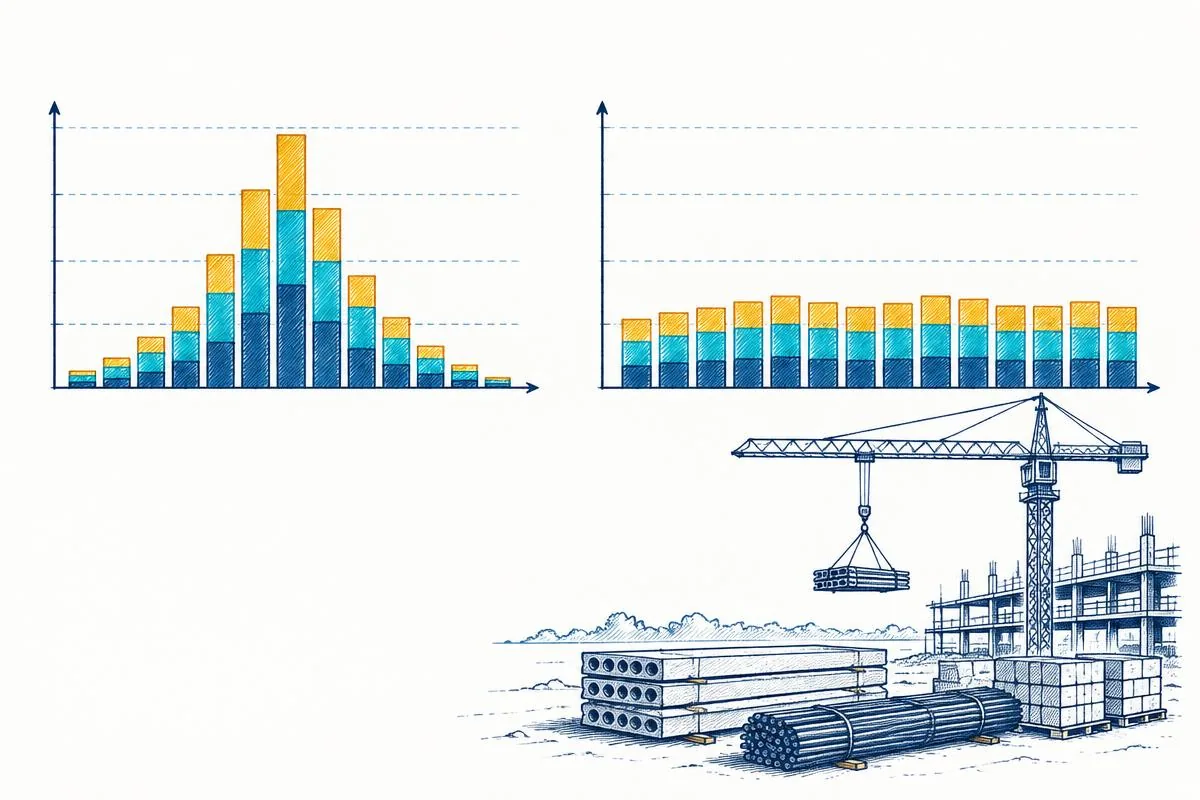 Construction & ProjectResource histograms and levelling: spot the peak earlyBuild a resource histogram, distinguish levelling from smoothing, and test whether a flatter labour plan is genuinely deliverable.16 November 2026 · 8 min read
 Construction & ProjectCrew size, man-hours and productivity: labour arithmeticConvert scope and production rates into labour-hours and crew sizes, then test utilization, whole-shift bookings and labour cost.16 November 2026 · 8 min read
 Construction & ProjectActivity duration from production ratesConvert quantities, crew outputs and working hours into defensible activity durations without double-counting productivity allowances.14 November 2026 · 8 min read
Sources and standards
About the author
Dr. Hassan Khames Eliwa holds a PhD in Construction & Built Environment and has more than 20 years of international project controls experience. He is Director of Eliwa Project Controls Limited in Auckland and founder of PMMilestone.org and PMMilestone.com.
Buy me a coffee