Schedule Variance Days Calculator
Compare measured construction progress with elapsed working time on one explicit calendar. This calculator converts physical percent complete into progress-based earned working days, reports a signed schedule variance, and projects a finish using the average progress achieved so far.
By Dr. Hassan Khames EliwaLast updated
Result
Earned minus elapsed; positive is ahead under uniform planned progress.
- Planned working days
- 22
- Elapsed working days
- 10
- Progress-based earned working days
- 8.80
- Forecast finishLinear progress extrapolation; not critical-path or earned-schedule analysis.
- 2026-12-22
- Remaining working days (rounded up)
- 15
How it works
Establish the baseline and cutoff
Enter the approved planned start and finish, then the reporting status date. At 100% complete, the status date becomes the actual finish. Choose Saturday–Sunday, Friday–Saturday or Sunday-only weekends and list explicit holiday dates. Observed public holidays are not inferred. The same calendar applies to baseline duration, elapsed time and future additions, so a calendar change requires a separate comparison rather than quietly mixing different working weeks.
Count time consistently
The calculation imports the existing working-days calculator’s pure compute function. Its convention excludes the start and includes the end when that end is a working day. Equal dates therefore contain zero elapsed working days. A planned interval must contain at least one working day. Dates are validated by the shared implementation, which supports 1900 through 2100 and bounds long intervals. Count results are whole working days; progress equivalents can remain fractional.
Translate physical progress into time equivalents
Let D be planned working days, E be elapsed working days and p be completion expressed as a fraction. Earned working days equal D × p. Schedule variance in days equals D × p − E. Positive means ahead and negative means behind under a uniform planned-progress assumption. This is not conventional monetary earned-value SV, and it is not formal earned schedule: no time-phased baseline curve is interpolated. A front-loaded procurement package or back-loaded commissioning package can therefore produce misleading signals here even when the arithmetic is correct.
Forecast without hiding the assumption
For incomplete positive progress, remaining working days equal E × (1 − p) ÷ p. The calculator rounds that remainder upward to a whole working day and adds it after the status date using the selected calendar. It assumes average progress continues unchanged, with no critical-path effects, resource bottlenecks or acceleration. At zero progress no forecast is available. Positive incomplete progress with zero elapsed working days is rejected because the observed rate cannot be estimated. At 100%, the actual finish is returned without extrapolation.
Worked example
Scenario 1: behind a ten-day baseline
Use planned start 2026-11-02, planned finish 2026-11-16, status 2026-11-09, 40% complete, Saturday–Sunday weekends and no holidays. Planned duration is 10 working days, elapsed duration is 5, earned duration is 4.00 and SV is −1.00 day. Remaining time is 5 × 0.60 ÷ 0.40 = 7.5, rounded up to 8 working days. Adding those days after the status date gives forecast finish 2026-11-19.
Scenario 2: completed work with a holiday
Keep planned start 2026-11-02 and finish 2026-11-16, but enter 2026-11-17 as status, 100% complete and holiday 2026-11-11. The planned interval now contains 9 working days and elapsed time contains 10. Earned duration is 9.00 working days, SV is −1.00 day and actual finish is 2026-11-17. No remaining-days extrapolation is necessary. The holiday changes both baseline and elapsed counts, rather than being subtracted twice from only one side.
Expert tips
Common mistakes
- Do not treat the progress-derived variance as contractual delay entitlement. Responsibility, contemporaneous programmes and criticality require evidence beyond one overall percentage.
- Do not enter the baseline finish as the status date merely because it is already known. The cutoff must match the date through which reported progress was measured.
- Do not round physical progress to whole milestones simply to improve the forecast. Small percentage changes near zero can move a linear extrapolation dramatically.
Frequently asked questions
Is this formal earned schedule?
No. It assumes planned progress is uniform over the working duration. Formal earned schedule maps earned value onto a time-phased planned-value curve, which this calculator does not request.
Can I include weekends as working days?
The Sunday-only option makes Saturday a working day. A seven-day workweek and rotating shift calendars are not supported; use a detailed scheduling tool for those patterns.
Why is the start excluded?
This matches the shared working-days convention. A Monday-to-Tuesday interval contains one working day, not two. Keep that interpretation consistent with the baseline you are checking.
What happens at zero completion?
Earned days are zero and variance is minus elapsed days. Forecast finish remains unavailable because there is no demonstrated progress rate to extrapolate.
Can the status be after planned finish?
Yes. Elapsed working days continue beyond the baseline finish so that late work remains visible rather than being artificially capped at the planned duration.
Why round remaining time upward?
The calendar helper adds whole working days. Rounding up avoids implying an unsupported intraday finish, while earned days and variance retain two-decimal precision.
Related calculators
Related guides
 Construction & ProjectCPI and SPI trends: read the direction, not just the numberRead period and cumulative CPI and SPI together, test the data behind changing trends, and turn earned-value signals into practical decisions.16 November 2026 · 8 min read
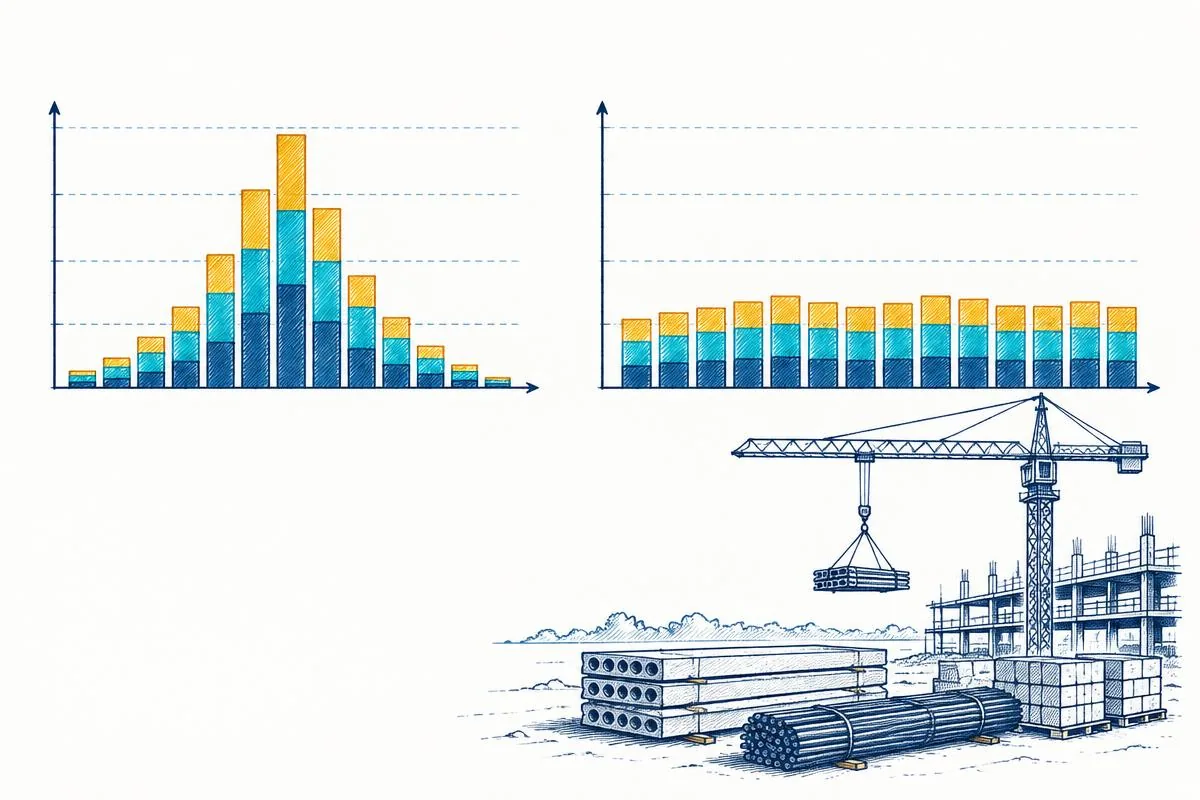 Construction & ProjectResource histograms and levelling: spot the peak earlyBuild a resource histogram, distinguish levelling from smoothing, and test whether a flatter labour plan is genuinely deliverable.16 November 2026 · 8 min read
 Construction & ProjectCrew size, man-hours and productivity: labour arithmeticConvert scope and production rates into labour-hours and crew sizes, then test utilization, whole-shift bookings and labour cost.16 November 2026 · 8 min read
Sources and standards
About the author
Dr. Hassan Khames Eliwa holds a PhD in Construction & Built Environment and has more than 20 years of international project controls experience. He is Director of Eliwa Project Controls Limited in Auckland and founder of PMMilestone.org and PMMilestone.com.
Buy me a coffee