
Unit Rate Build-Up Calculator
This unit rate build-up calculator combines labour, plant and materials into a selling rate for one measured unit of work. It applies waste to materials, overhead to direct cost and a true profit margin to selling price, keeping the calculation visible for estimate reviews.
By Dr. Hassan Khames EliwaLast updated
Result
- Material waste per unit
- $3.00
- Direct cost per unit
- $63.00
- Overhead per unit
- $6.30
- Cost before profit per unit
- $69.30
- Profit per unit
- $17.33
How it works
Define one consistent measured unit
Choose what the rate buys before entering money: a square metre of finished paving, a cubic metre of placed concrete or another clearly described output. All three cost inputs must refer to that same unit. The calculator does not infer productivity from a wage or hourly plant rate. Convert those source rates into cost per measured unit before using this build-up.
Include realistic paid time, employer costs and utilisation in the labour allowance as appropriate to your estimate basis. For plant, distinguish an operated hire rate from a bare-machine rate so you do not omit or duplicate the operator. Materials should be entered at their base quantity cost per finished unit before the separate waste allowance. Record whether freight, small tools, testing and supervision sit in a direct component or in overhead.
Follow the order of operations
Material waste cost equals base material cost multiplied by the waste percentage. Direct cost equals labour plus plant plus base materials plus material waste. Overhead equals direct cost multiplied by the overhead percentage. Cost before profit is direct cost plus overhead.
Selling rate equals cost before profit divided by one minus the profit margin fraction. Profit is selling rate less cost before profit. This is a margin calculation, not a markup calculation: the percentage is measured against the selling price. The margin versus markup guide explains why simply adding the margin percentage to cost gives a different commercial result.
Keep the estimate boundary visible
The tool uses one overhead percentage and one profit margin for the whole unit. It does not model tax, escalation, discounts, bonds, retention finance or risk allowances separately. Add those only within a documented pricing structure that avoids double counting. The GAO Cost Estimating and Assessment Guide provides broader guidance on estimate scope, assumptions and documentation, rather than endorsing any particular waste or profit percentage.
Use the output as a transparent rate check. A mathematically correct selling rate can still be commercially weak if the productivity allowance or measured quantity is unrealistic. Revisit the source build-up when scope changes instead of adjusting the final price until it looks familiar.
Worked example
Example: rate with waste, overhead and margin
Labour is $20, plant $10 and base materials $30 per unit. Material waste at 10% adds $3, making direct cost $63. Overhead at 10% adds $6.30, producing a cost before profit of $69.30. At a 20% selling-price margin, the selling rate displays as $86.63 and profit as $17.33. The calculation retains the unrounded rate internally before formatting money.
Example: straightforward direct-cost rate
With labour of $15, plant of $5, materials of $20 and zero waste, overhead and margin, material waste is $0. Direct cost and cost before profit both equal $40. The selling rate is $40 and profit is $0. This isolates the base components when checking a more detailed estimate.
Expert tips
Common mistakes
- Entering an hourly wage directly as a cost per square metre. The source rate must first be divided by the appropriate output or otherwise converted to the chosen measured unit.
- Applying waste to labour and plant unintentionally. This model applies waste to materials only; any extra installation effort should be reflected in the labour or plant allowance.
- Confusing margin with markup. The calculator divides cost by the complement of the margin, rather than multiplying cost by one plus the entered percentage.
Frequently asked questions
What is one unit?
It is the measured output you define for the estimate. The calculator is currency-neutral and quantity-neutral, so the input costs must already share a consistent currency and unit of finished work.
Does waste affect all costs?
No. The waste percentage applies only to base materials. Labour or plant consequences of handling waste need to be allowed separately in those input costs if they are relevant.
What is the overhead basis?
Overhead is applied to direct cost after material waste. The result then becomes part of cost before profit, so profit margin is applied to both direct cost and overhead through the selling-price formula.
Why must margin be below 100%?
The formula divides cost by one minus the margin fraction. A margin at or above the full selling price does not produce a supported finite selling rate in this pricing model.
Can the rate be zero?
Yes. Zero costs and a valid margin produce a zero selling rate. That may be useful for checking an excluded item, but it does not confirm that the underlying scope is genuinely cost-free.
Are taxes included?
There is no separate tax calculation. State whether input costs include nonrecoverable taxes, and apply any output tax according to the appropriate rules outside this build-up to avoid mixing incompatible bases.
Related calculators
Related guides
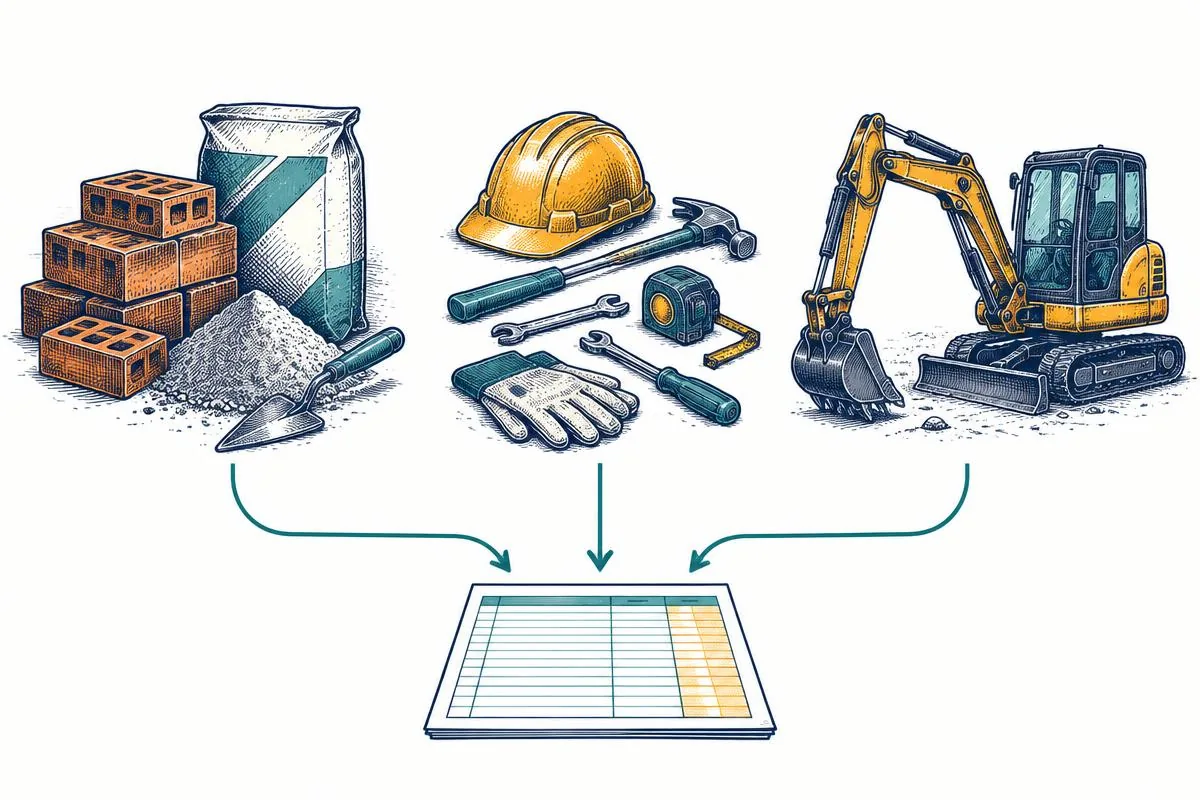 Construction & ProjectBuilding a Unit Rate That Can Be CheckedBuild a unit rate from materials, labor, plant, productivity, overhead, and markup, with a complete worked example and checks.17 November 2026 · 8 min read
 FinancialMargin vs markup: the pricing mistake that eats profitA percentage added to cost is not the same percentage retained from sales. That denominator mistake can quietly undermine a pricing plan.14 November 2026 · 7 min read
 Construction & ProjectCrew size, man-hours and productivity: labour arithmeticConvert scope and production rates into labour-hours and crew sizes, then test utilization, whole-shift bookings and labour cost.16 November 2026 · 8 min read
Sources and standards
About the author
Dr. Hassan Khames Eliwa holds a PhD in Construction & Built Environment and has more than 20 years of international project controls experience. He is Director of Eliwa Project Controls Limited in Auckland and founder of PMMilestone.org and PMMilestone.com.
Buy me a coffee