Ohm’s Law Calculator
Solve voltage, current or resistance from the other two quantities using Ohm’s law. Choose the unknown first, then enter the two known positive magnitudes in volts, amperes and ohms.
By Dr. Hassan Khames EliwaLast updated
Result
How it works
One relationship, three rearrangements
Ohm’s law is V = I × R: voltage equals current multiplied by resistance. To solve current, divide voltage by resistance, I = V ÷ R. To solve resistance, divide voltage by current, R = V ÷ I. The selector chooses the rearrangement and hides the field that would otherwise contain the unknown.
This interface intentionally solves from exactly two known entries. An old value left in the hidden field is ignored, so it cannot overrule the selected calculation. It also means the tool is not checking whether three independent measurements agree. To investigate that question, calculate the missing quantity and compare it with the separately measured value yourself.
Work in base electrical units
Enter amperes, not milliamperes, and ohms, not kilohms. For example, a meter reading in milliamperes must be divided by one thousand before entry as amperes. Unit prefixes are convenient on instruments but do not disappear from the arithmetic. The unit converter and scientific calculator can help with supporting calculations.
Know where the model applies
The simple relationship describes an ohmic element under the relevant operating conditions. Resistance can vary with temperature, and components such as diodes do not generally follow a fixed-resistance model over their operating range. AC circuits with reactive elements require impedance and phase information that this calculator does not collect. Treat the output as a component-level DC or purely resistive calculation, not a complete circuit analysis.
The calculator accepts positive magnitudes only. It deliberately excludes zero and negative inputs rather than attempting to infer open circuits, ideal shorts or a signed circuit convention. Never use a numerical result as permission to touch an energized circuit or bypass electrical safety procedures.
Worked example
Example 1: current through a resistor
Choose Current, enter voltage 12 V and resistance 6 Ω. The calculation is 12 ÷ 6, so the result is 2 A. This describes the current predicted for that voltage across that resistance, assuming the component behaves as the model requires. It does not tell you whether the resistor can safely dissipate the resulting heat.
Example 2: choosing an equivalent resistance
Choose Resistance, enter voltage 9 V and current 0.03 A. Dividing 9 by 0.03 gives 300 Ω. The current entry is thirty milliamperes expressed in amperes. Selecting Voltage with current 2 A and resistance 6 Ω instead reproduces 12 V, demonstrating the third rearrangement.
Expert tips
Common mistakes
- Putting milliamperes into the ampere field. Entering 30 when you mean thirty milliamperes changes the current by a factor of one thousand. Convert the value before using the base-unit field.
- Using fixed resistance for every component. A filament lamp, diode or temperature-sensitive device may have operating behaviour that a single constant resistor does not capture. Consult the component data rather than forcing the model.
- Confusing resistance with energy use. Ohms describe resistance, not electricity consumption. For a billed-energy estimate use an appropriate power and duration calculation, such as the electricity cost calculator.
Frequently asked questions
Can it solve all three quantities?
Yes, one at a time. Select voltage, current or resistance, and the corresponding formula uses the other two visible fields. The selected unknown is never treated as a third required input.
Why are zero values rejected?
Zero can represent special or ambiguous ideal-circuit cases, including division by zero for some rearrangements. This tool restricts its scope to two positive known magnitudes rather than assigning those cases misleading ordinary results.
Can I enter negative current?
Not here. Negative signs can be valid within a defined circuit reference convention, but this calculator works with positive magnitudes. A signed circuit solver is more suitable for directional analysis.
Does this calculate AC impedance?
No. It has no frequency, capacitance, inductance or phase inputs. For purely resistive AC quantities the familiar magnitude relationship can apply, but reactive circuits require a more complete model.
Is the displayed precision a measurement guarantee?
No. Up to eight decimal places are available for numerical readability. Meter uncertainty, component tolerance and temperature can dominate the real-world accuracy long before the last displayed digit matters.
Related calculators
Related guides
 MathPercentages people get wrong: change, difference and pointsThe denominator determines the answer. Learn to distinguish percentage change, symmetric difference and percentage-point movements.14 November 2026 · 7 min read
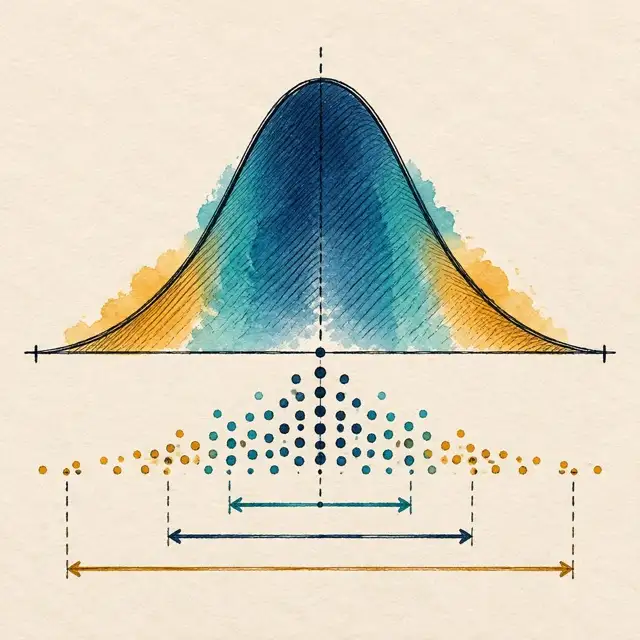 MathStandard deviation without the jargonThe average tells you the centre. Standard deviation helps describe the spread, provided you know what the data represents.14 November 2026 · 7 min read
Sources and standards
About the author
Dr. Hassan Khames Eliwa holds a PhD in Construction & Built Environment and has more than 20 years of international project controls experience. He is Director of Eliwa Project Controls Limited in Auckland and founder of PMMilestone.org and PMMilestone.com.
Buy me a coffee